
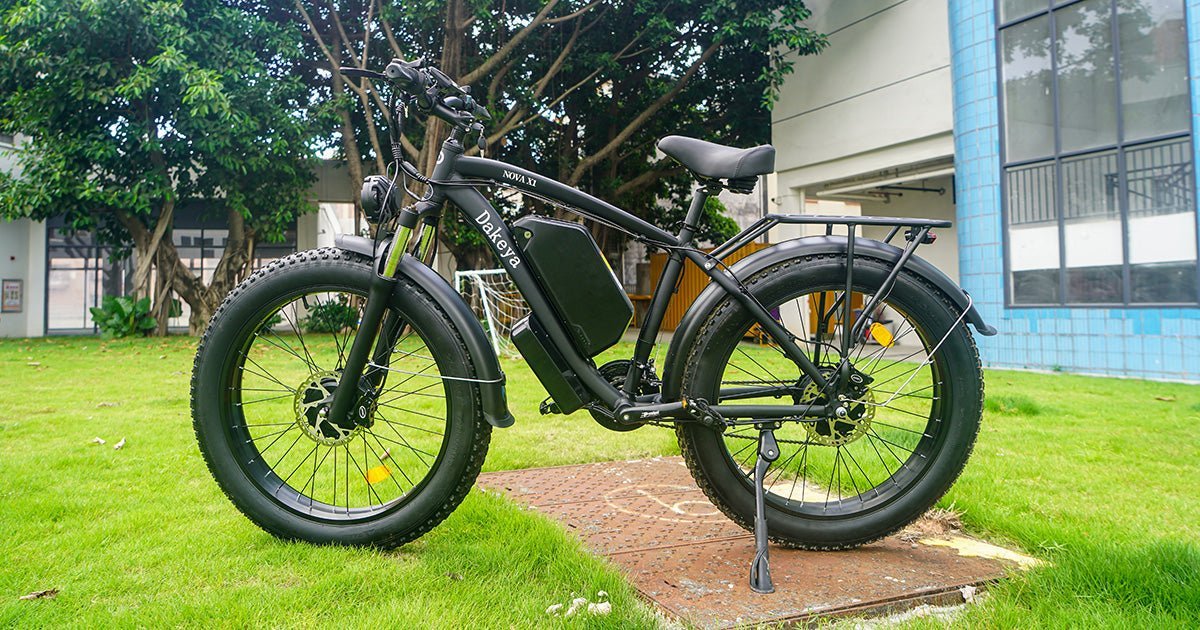
An e-bike battery affects much more than the distance you can travel. It also influences acceleration, hill-climbing performance, overall weight, charging time, and the long-term cost of owning an electric bike.

For most riders, there are two different questions behind "How long does an e-bike battery last?"
- How far can it travel on one charge?
- How many years or charge cycles will it remain useful?
A well-maintained lithium-ion e-bike battery can typically remain useful for about 3–4 years or approximately 800–1,000 charge cycles. On compatible long-range Dakeya models, riders can expect around 30 miles in throttle-only riding and up to 75 miles with pedal assist, depending on riding conditions.
This guide explains what those numbers mean, why real-world range changes, how 48V, 52V, and 60V systems differ, and when a battery may need replacement.
How Many Miles Can an E-Bike Travel on One Charge?
A high-capacity e-bike battery can provide approximately:
- Around 30 miles in throttle-only mode
- Up to 75 miles with pedal assist
Throttle-only riding asks the motor to do nearly all the work, so it consumes energy faster. Pedal assist combines the rider's effort with motor support, allowing the same battery to cover a much longer distance.
The 75-mile figure should be treated as a maximum assisted range—not a guarantee for every ride. Actual range depends on rider weight, assist level, speed, temperature, hills, tire pressure, terrain, wind, cargo, and how often the bike starts and stops.
Why Throttle-Only Range Is Shorter
At higher speeds, aerodynamic resistance rises sharply. A powerful motor also draws more current during acceleration and climbing. If you frequently use full throttle, dual-motor mode, or the highest power setting, the battery will discharge considerably faster than it will in a moderate pedal-assist setting.
For longer trips, riders can improve range by:
- Using a low or medium pedal-assist level
- Pedaling during acceleration and on hills
- Maintaining a steady, moderate speed
- Using single-motor mode when full power is unnecessary
- Keeping the tires properly inflated
- Avoiding unnecessary cargo
How Many Years Does an E-Bike Battery Last?
Under normal use and proper maintenance, an e-bike lithium-ion battery can usually last 3–4 years or approximately 800–1,000 charge cycles.
A charge cycle does not necessarily mean plugging the battery in once. One cycle is the equivalent of using 100% of the battery's capacity. For example, using 50% today and 50% tomorrow equals roughly one full cycle.
Battery capacity gradually declines with age. A battery does not normally stop working immediately after reaching a certain number of cycles. Instead, riders may notice:
- Less range per charge
- Faster voltage drop under acceleration
- Longer or irregular charging behavior
- Earlier low-voltage shutoff
- Reduced performance in cold weather
How quickly this happens depends heavily on charging habits, storage conditions, temperature, and how hard the battery is used.
What Reduces E-Bike Battery Range?
1. Rider Weight and Cargo
A heavier total load requires more energy to accelerate and climb. The total load includes the rider, bags, tools, groceries, and any other cargo. The closer the bike is to its maximum load rating, the more range can decrease—especially on hilly routes.
2. Riding Speed
Higher speed creates much more aerodynamic drag. Riding continuously near maximum speed can consume substantially more power than cruising at a moderate pace. Frequent hard acceleration also creates high current demand.

3. Cold Temperatures
Lithium-ion batteries deliver less usable energy in cold conditions. A battery may show reduced range during winter and recover some performance when the temperature rises. This temporary cold-weather range loss does not automatically mean the battery is damaged.
4. Hills and Terrain
Long climbs, soft sand, mud, snow, and loose gravel require more motor torque. Rough terrain also creates greater rolling resistance than smooth pavement. Steeper and longer hills therefore reduce range more quickly.
5. Tire Pressure, Wind, and Stop-and-Go Riding
Low tire pressure increases rolling resistance. Strong headwinds increase aerodynamic load. Repeated stopping and accelerating uses more energy than maintaining a consistent speed. All three can noticeably reduce the distance available from one charge.
48V vs. 52V vs. 60V E-Bike Batteries
Voltage describes the electrical potential of the battery system. In general, a higher-voltage system can support greater power with less current for the same wattage, but voltage alone does not determine range.
- 48V battery: Typical full-charge voltage is 54.6V. Commonly used for commuting and moderate-power riding, with lower cost and weight.
- 52V battery: Typical full-charge voltage is 58.8V. Suitable for balanced commuter and performance use, with more performance headroom than a 48V system.
- 60V battery: Typical full-charge voltage is 67.2V. Better suited to high-power, dual-motor, hill-climbing, and off-road use.
48V Batteries
A 48V system is common on commuter and entry-to-mid-level performance e-bikes. It can provide a practical balance of cost, weight, range, and readily available replacement parts.
52V Batteries
A 52V system provides slightly more voltage and energy than an equivalent-capacity 48V system. It is often chosen by riders who want stronger performance without moving to a larger 60V platform.
60V Batteries
A 60V system is better suited to high-power motors, dual-motor bikes, heavier loads, steep hills, and off-road riding. Dakeya NOVA X1 and Da03 use 60V 25Ah batteries, equal to approximately 1,500 watt-hours of nominal energy.
Voltage Does Not Tell You the Whole Range Story
Battery energy is estimated using: Watt-hours = Voltage × Amp-hours
- 48V × 20Ah = 960Wh
- 52V × 20Ah = 1,040Wh
- 60V × 20Ah = 1,200Wh
- 60V × 25Ah = 1,500Wh
A higher watt-hour rating generally means more stored energy. However, a high-powered 60V bike may also consume energy faster when ridden at high speed or in dual-motor mode. That is why battery voltage, capacity, motor power, riding mode, and real-world conditions must be considered together.
Important compatibility warning: Never replace a 48V battery with a 52V or 60V battery unless the motor controller, display, wiring, charger, and other electrical components are specifically designed for that voltage. Always use the correct charger for the battery.
How to Charge an E-Bike Battery Correctly
Good charging habits can extend the useful life of a lithium-ion battery.
- Use the correct manufacturer-approved charger. A charger with the wrong output voltage can damage the battery or create a fire risk.
- Allow the battery to cool before charging. After a demanding ride, wait until the battery returns to a normal temperature.
- Charge in a dry, ventilated area away from flammable materials. Do not cover the battery or charger while charging.
- Avoid regularly draining the battery to empty. Recharging around 20%–30% remaining is generally gentler than repeated deep discharge.
- Do not leave the battery charging unattended for long periods. Disconnect it after charging is complete according to the product instructions.
- Protect it from extreme temperatures. Avoid charging a frozen, overheated, wet, swollen, or physically damaged battery.
- For long-term storage, keep a partial charge. Approximately 40%–60% is suitable for storage. Check it periodically instead of leaving it empty for months.
- Recharge a stored battery at least once every three months. Even when the bike is switched off, the battery management system and natural self-discharge gradually consume energy. Check the charge level monthly when possible and top it back up to the storage range before it becomes deeply discharged.
- Do not leave the battery empty for an extended period. A lithium-ion pack left at or near 0% can enter deep discharge. This may permanently reduce capacity, prevent the charger from recognizing the battery, or damage individual cells. Recharge it promptly after a low-battery shutdown rather than storing it empty.
- Keep the terminals clean and dry. Inspect the battery mount, connector, lock, cable, and housing regularly.
If a battery becomes unusually hot, develops an odor, swells, leaks, makes unusual sounds, or shows physical damage, stop using and charging it immediately. Move away from the battery if it is safe to do so and contact qualified service support.
When Should You Replace an E-Bike Battery?
A battery may need professional testing or replacement when it has a major and persistent loss of range, cannot hold a charge, shuts down under normal load, has damaged connections, or shows physical warning signs.
The following approximate pack voltages are important low-voltage reference points for common lithium-ion configurations:
- 48V battery: approximately 36.4V
- 52V battery: approximately 39.2V
- 60V battery: approximately 44.8V
These readings are low-voltage protection or diagnostic thresholds—not automatic proof that the battery is permanently worn out. If the pack reaches this level during use, stop riding and recharge it with the correct charger. A single low reading after discharge does not by itself mean replacement is required.
The battery should be inspected and may need replacement if it:
- Remains abnormally low after a complete, correct charge
- Drops rapidly toward the low-voltage threshold under light or normal load
- Shuts down much earlier than it did when new
- Provides substantially less usable range after charging
- Cannot complete charging or repeatedly triggers protection
- Has swelling, leakage, impact damage, water damage, burned connectors, or unusual heat
Do not open or attempt to repair a lithium-ion battery pack yourself. Internal cells can retain dangerous energy even when the display appears empty.
How Much Does an E-Bike Battery Replacement Cost in the U.S.?
Replacement cost depends on voltage, capacity, cell quality, battery management system, enclosure, connector, and model compatibility.
Dakeyabike currently lists compatible removable lithium-ion replacement batteries at approximately $399–$599, depending on the model and specification. Options listed on the website include 48V, 52V, and 60V batteries, including compatible batteries for the NOVA X1 and Da03.
Check current Dakeya replacement battery options and prices: dakeyabike.com/products/dakeya-bikes-removable-lithium-ion-batteries
In-stock replacement batteries ship from the United States. Delivery typically takes 5–7 business days, although destination, inventory, weather, and carrier conditions can affect delivery.
Many Dakeya batteries are removable and can be replaced by the owner. Before ordering, confirm the exact bike model, voltage, capacity, connector, battery rail, lock position, and charger compatibility. If anything is unclear, contact Dakeya support before purchasing.
Are the NOVA X1 and Da03 Right for You?
The Dakeya NOVA X1 and Dakeya Da03 are high-powered, 60V fat-tire electric bikes designed for adult riders.
They are best suited to:
- Riders aged 18 or older
- Men and women approximately 5'5" (1.65m) or taller
- Riders who want strong acceleration and hill-climbing capability
- Heavier riders or riders carrying cargo within the bike's rated load limit
- Long-distance riders who want a 60V 25Ah removable battery
- Off-road, trail, gravel, rural-road, and mixed-terrain riding
- Riders who value fat-tire stability and hydraulic braking
NOVA X1
The NOVA X1 is designed for riders who prioritize maximum performance. It features dual motors with up to 6,000W total peak output, a 60V 25Ah battery, 26 × 4.0-inch fat tires, hydraulic disc brakes, and a maximum assisted range of up to 75 miles under suitable conditions.
Da03
The Da03 combines dual-motor performance with front and center suspension, making it a strong choice for rougher terrain and riders who prioritize comfort and control. It also uses a 60V 25Ah removable battery and supports up to 75 miles of pedal-assisted range under suitable conditions.
Both are powerful machines, not lightweight casual bicycles. New riders should begin at the lowest power setting in a controlled area, wear appropriate protective equipment, and learn the bike's braking and handling before increasing speed.
Local e-bike rules vary by state, city, trail, and land manager. High-power or unlocked operation may be restricted to private property or designated off-road areas.
Compare all Dakeya electric bikes
Frequently Asked Questions
Is 75 miles a realistic e-bike range?
It is possible as a maximum pedal-assisted range under favorable conditions. Throttle-only riding is closer to approximately 30 miles on compatible long-range Dakeya models. Rider weight, speed, temperature, hills, terrain, wind, tire pressure, and assist level can reduce either figure.
Should I charge my e-bike after every ride?
You do not need to fully charge it after every short ride. Recharge based on the next trip and avoid regularly leaving it completely empty.
For long-term storage, keep it at approximately 40%–60%, check the level monthly when possible, and recharge it at least once every three months. Never store it empty for an extended period because deep discharge can permanently damage the cells.
Can I use a 52V battery on a 48V e-bike?
Not unless the complete electrical system is rated and configured for 52V. The controller, display, charger, wiring, and accessories must all be compatible. Never assume that a battery fits simply because the connector looks similar.
Does a Higher-Voltage Battery Always Provide More Range?
No. Voltage is only one part of the calculation. Amp-hours determine capacity, while motor power, speed, terrain, rider weight, and riding mode determine consumption. Compare watt-hours and system efficiency—not voltage alone.
Can I Replace a Dakeya Battery Myself?
Compatible removable batteries can generally be swapped by the owner, but the exact model and electrical specifications must match. Turn off the bike, remove the key, follow the product instructions, and contact support if the battery mount or connector is damaged.
Final Takeaway
For compatible long-range Dakeya models, a practical expectation is around 30 miles using throttle only and up to 75 miles with pedal assist. With normal care, the battery can typically remain useful for 3–4 years or about 800–1,000 charge cycles.
To get the most from it, ride at moderate speeds when range matters, use pedal assist, avoid extreme temperatures, recharge before repeated deep discharge, and store the battery partially charged.
When replacement becomes necessary, choose a battery that exactly matches the bike's voltage, capacity, mount, connector, and charger.
Shop Dakeya electric bikes | View compatible replacement batteries


Share:
Best Electric Mountain Bikes for Hunting, Camping & Off-Road Adventures in 2026
UL 2849 vs. UN 38.3: How to Verify E-Bike Safety Claims