
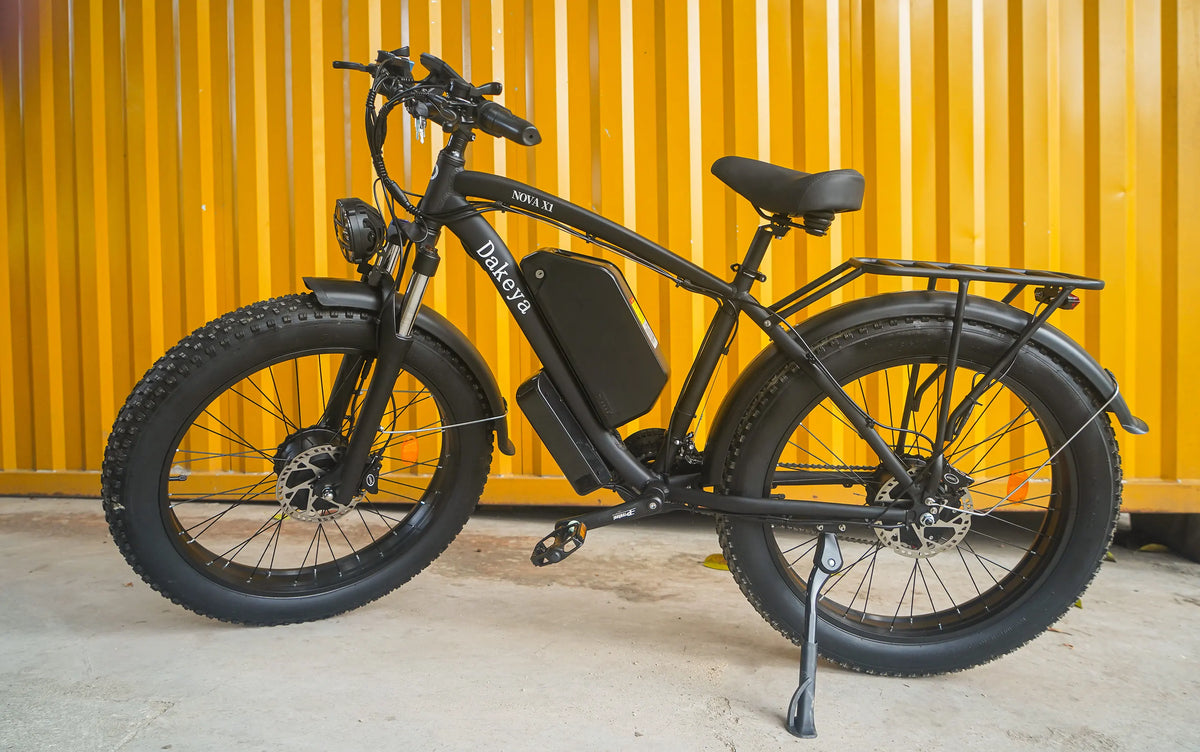
Can an e-bike handle your hills? Start with the steepest section, how long it lasts, your total load and the surface—not just the largest motor number. A short dry climb and a long gravel ascent can ask very different things of the same bike.
This guide is for adult riders comparing high-performance fat-tire bikes, including the Dakeya NOVA X1 and DA03. It helps you collect useful route information, understand the limits of advertised specifications and ask better questions before buying.
Quick answer: Choose for the complete uphill-and-downhill route. Peak power alone cannot establish climbing ability, a safe maximum slope, continuous-duty capability or legal access.
1. Measure the hill: percent grade is not degrees
Road gradients are often expressed as a percentage. Grade equals vertical rise divided by horizontal distance, multiplied by 100. A hill rising 10 feet over 100 horizontal feet is a 10% grade. That is about 5.7 degrees, not 10 degrees.
| Vertical rise over 100 horizontal feet | Grade | Approximate angle |
|---|---|---|
| 5 feet | 5% | 2.9° |
| 10 feet | 10% | 5.7° |
| 15 feet | 15% | 8.5° |
| 20 feet | 20% | 11.3° |
These are mathematical examples, not ratings or recommended riding limits for any Dakeya model. A 45-degree slope is a 100% grade; confusing degrees with percent can radically change the route you think you are buying for.
Use a route planner or elevation profile to identify the steepest section and its length. GPS elevation and averaged route gradients can miss a short steep ramp, so treat estimates cautiously and seek local route information. Record both the gradient and the distance over which it occurs.
2. Record length, load and surface before comparing motors
- Hill length: a short rise and a sustained climb create different heat and energy demands.
- Rider and cargo: include clothing, backpack, locks, water and accessories; follow both the total-load limit and individual component limits.
- Surface: loose gravel, wet leaves, sand and potholes change traction and control.
- Starts: restarting halfway up a slope can be harder than approaching it steadily.
- Conditions: wind, cold, battery charge and tire condition affect the result.
- The descent: record the downhill length, bends, visibility and places where you can safely stop.
A useful support message is: “My total rider-and-cargo load is 220 lb. The route includes a roughly 10% paved climb for half a mile, followed by a descent of similar length. I need to know whether this exact bike configuration is suitable.” This is an example request, not a performance claim.

3. Read power numbers without turning them into promises
The NOVA X1 is listed at 6000W combined peak; the DA03 at 5500W combined peak. Those figures describe peak output, not continuous power. They do not tell you how long a motor can maintain a particular output while climbing slowly.
Controller limits, motor design, temperature protection, battery condition, total mass and available grip all influence hill performance. A larger peak number is therefore only one comparison point. Ask for model-specific documentation or a relevant test with the rider load, grade, hill length, starting charge and riding mode disclosed. If no such test exists, do not convert a promotional slope claim into a guaranteed result.
Mechanical gears help you pedal at a manageable cadence. On a hub-motor bicycle, shifting the bicycle drivetrain does not give the hub motor the same gearing advantage as a mid-drive motor that drives through the chain. Learn the exact controls from the model manual and installation guide.
4. Dual motors help only when the tires can use the force
Two driven wheels can change how force is distributed, but they cannot create unlimited grip. On loose or slippery ground, abrupt power can produce wheelspin instead of useful progress. Fat tires and suspension also cannot make every surface or slope suitable.
Practice the documented drive settings on a level, permitted area first. Approach unfamiliar terrain conservatively and avoid abrupt acceleration or steering. If the bike struggles, loses grip, cuts power or behaves abnormally, stop safely and reassess. Do not repeatedly force it up the same hill or bypass protection features.
Choose an alternative route when the surface, slope or available stopping space exceeds your ability or the bike’s documented limits. Do not assume pushing a heavy bike on a steep slope is automatically safe; plan a controlled exit before committing.

5. Plan battery reserve for elevation, not the advertised maximum range
Both current product pages list a 60V 25Ah battery, equivalent to 1500Wh nominal energy. Their 75+ mile advertised range is not a hilly-route guarantee. More mass, repeated acceleration, soft surfaces and climbing increase energy demand.
An illustrative physics calculation shows why elevation matters: lifting a combined 120 kg bike, rider and cargo through 100 vertical meters requires about 32.7Wh of mechanical energy, using mass × gravity × height. Actual battery consumption is higher because the drive system is not perfectly efficient, and rolling resistance and air drag still consume energy. This is not a range estimate for either model.
- Start with a shorter loop near a safe return point.
- Record battery use on your own route, with a similar load and riding mode.
- Leave a meaningful reserve for detours, wind and unexpected stops.
- Do not plan around recovering energy on the way down; regenerative braking is not verified here.
- Follow the manual’s temperature and charging limits after the ride.
The CPSC micromobility guidance recommends following manufacturer directions, using the supplied or recommended charger and remaining present while charging. A larger battery does not remove these precautions.
6. Check the descent as carefully as the climb
Reaching the top does not prove the bike is suitable for the whole trip. Both models list hydraulic disc brakes, but braking also depends on pad and rotor condition, surface grip, total load, speed and heat during a long descent.
Before riding, check the brakes, tires, wheel security and controls according to the manual. Reduce speed early, use the model’s documented braking technique and choose a route with safe stopping options. If lever feel changes, braking weakens, there is unusual noise or a fault appears, stop safely and obtain inspection rather than continuing downhill.
NHTSA bicycle safety guidance emphasizes a bike that fits, working brakes, helmet use, visibility and route planning. These general principles are useful, but they do not establish that a high-power configuration is legally a bicycle on your route.
7. NOVA X1 or DA03 for a hilly route?
| Buying question | NOVA X1 | DA03 |
|---|---|---|
| Published motor figure | 6000W combined peak | 5500W combined peak |
| Tires | 24 × 4.0 inches | 26 × 4.0 inches |
| Suspension | Front; no dedicated rear suspension | Front + central suspension |
| Battery | 1500Wh nominal | 1500Wh nominal |
| Hill decision | Ask whether the exact configuration suits your load, grade and climb duration. | Ask the same questions; additional suspension is not a climbing guarantee. |
For rough surfaces, the DA03’s additional central suspension is a meaningful feature to compare. For buyers prioritizing the higher published peak figure, the NOVA X1 is the relevant model to investigate. Neither comparison substitutes for verified route suitability, rider fit or legal access.
These high-power configurations may fall outside ordinary Class 1, 2 or 3 e-bike definitions. The National Park Service e-bike guidance illustrates that access is governed by specific definitions and local decisions. It is not permission to use either model on park trails. Check the actual land manager and state or local rules, including power, speed, registration and insurance requirements.
Questions to send before you buy
- What is the route’s steepest grade, and how long is that section?
- What is my total rider-and-cargo load?
- Is the surface paved, loose, wet or regularly damaged?
- Is there a verified hill test comparable to my route?
- What does the manual say about sustained climbs, temperature protection and descents?
- Can I legally use this exact configuration on the intended route?
- Can I mount, stop, store and handle the bike comfortably?
Frequently asked questions
Does 6000W peak mean the X1 climbs every hill?
No. Peak output does not establish a safe maximum grade, continuous climbing duration or traction. Ask about the specific route and load.
Is a 20% hill the same as 20 degrees?
No. A 20% grade is approximately 11.3 degrees. Always confirm the units before comparing a route with a specification.
Will both bikes travel 75 miles on hills?
Do not assume so. The advertised maximum is not a route guarantee. Measure your own consumption conservatively and leave reserve.
Is the DA03’s extra suspension proof of better climbing?
No. It changes the suspension layout; climbing performance still depends on the entire system, surface and rider load.
Choose with your actual route in hand
Bring a route profile, your total load and your storage and fit measurements to the buying decision. Compare the NOVA X1 and DA03, then ask Dakeya to check the relevant model information. If suitability cannot be confirmed, choose another route or vehicle rather than relying on a headline wattage number.
Related reading and sources
- NOVA X1 vs. DA03: specifications and buying differences
- Dual-motor vs. single-motor e-bikes
- Battery documentation: UN 38.3 and MSDS scope
By the Dakeya Editorial Team. Product specifications checked against the current NOVA X1 and DA03 product pages on November 5, 2026. General safety references: CPSC, NHTSA and National Park Service, linked above. Grade and energy examples are transparent calculations, not product test results. This article provides buying guidance, not an engineering certification or a promise of route suitability.


Share:
How to Charge and Store an E-Bike Battery Safely Indoors: Apartment Checklist
Your First 10 Rides on a High-Power E-Bike: A Progressive Setup Plan