
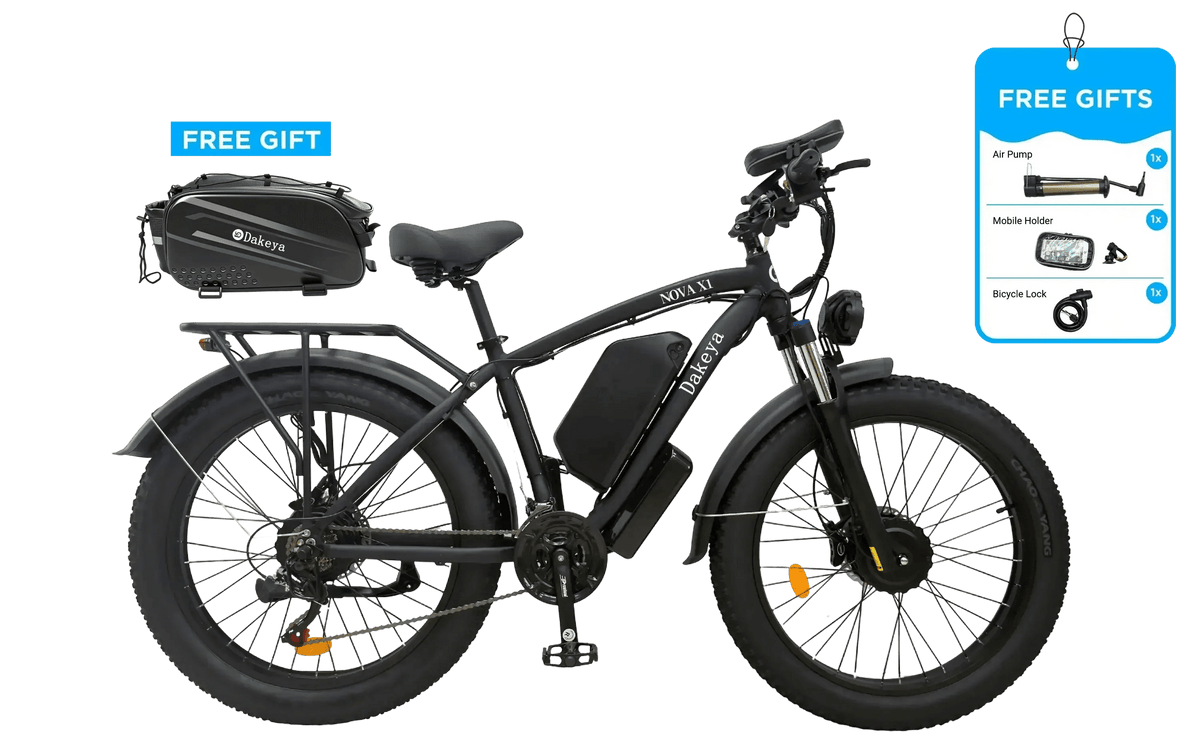
If you are comparing the Dakeya NOVA X1 vs. DA03, the answer is not simply “buy the one with the bigger motor number.” Both are high-performance, dual-motor fat-tire e-bikes with 60V 25Ah batteries, hydraulic disc brakes, 26 × 4.0-inch tires and UL 2849-certified electrical systems. The meaningful differences are how each bike is set up for speed, suspension, carrying capacity and price.
Quick answer: choose the NOVA X1 if maximum peak power, tested top speed and total load capacity matter most. Choose the DA03 if you prioritize front-and-center suspension, a useful rear rack and a lower purchase price.
NOVA X1 vs. DA03: specifications at a glance
| Feature | Dakeya NOVA X1 | Dakeya DA03 |
|---|---|---|
| Motor system | Dual 3000W peak motors; 6000W total peak | 2500W front + 3000W rear peak; 5500W combined peak |
| Advertised top speed | Up to 50 MPH, tested with a 150 lb rider | Up to 48 MPH under controlled test conditions |
| Battery | 60V 25Ah (1500Wh) | 60V 25Ah (1500Wh) |
| Advertised maximum range | Up to 75+ miles | Up to 75+ miles |
| Tires | 26 × 4.0-inch all-terrain fat tires | 26 × 4.0-inch fat tires |
| Suspension | Front shock absorption | Front + central shock absorption |
| Brakes | Hydraulic disc brakes | Hydraulic disc brakes |
| Drivetrain | 7-speed | Shimano 7-speed |
| Listed load capacity | Up to 550 lbs, rider + cargo | Up to 400 lbs combined; rear rack up to 120 lbs |
| Current listed price* | $1,499 | $1,399 |
*Prices and availability were checked when this guide was published and may change. Performance figures are manufacturer specifications; actual speed and range vary with rider weight, terrain, tire pressure, temperature, riding mode and local speed restrictions.
1. Power and acceleration: does 6000W vs. 5500W matter?
The NOVA X1 has two 3000W peak motors for a combined 6000W peak rating. The DA03 pairs a 2500W peak front motor with a 3000W peak rear motor for 5500W combined peak. On paper, the NOVA X1 has a 500W peak advantage.
That difference can matter to riders seeking the strongest available acceleration or extra reserve on steep, loose terrain. But peak wattage is not the only factor in real-world performance. Battery charge, controller tuning, traction, rider and cargo weight, grade and surface all affect how quickly an e-bike accelerates. Both bikes are substantially more powerful than ordinary low-power commuter e-bikes.
For controlled off-road riding, use the lowest effective power setting until you understand the bike’s response. More power is useful only when the tires can transfer it to the ground safely.

2. Speed: NOVA X1 has the slight edge
Dakeya lists the NOVA X1 at up to 50 MPH when tested with a 150 lb rider. The DA03 is listed at up to 48 MPH under controlled test conditions. That makes the NOVA X1 the faster choice on paper, but a two-mile-per-hour difference should not be the only reason to buy.
Actual speed varies, and high-performance configurations may not fit Class 1, Class 2 or Class 3 e-bike rules. Access to public roads, bike lanes and trails depends on state and local law. Check motor-power limits, speed limits, equipment, registration, licensing and permitted riding areas before use. Where required, reserve high-power operation for private property or designated off-road areas.
3. Battery and range: essentially a tie
Both models use a 60V 25Ah battery. Multiplying voltage by amp-hours gives a nominal energy capacity of 1500Wh, which matches Dakeya’s published specification for each bike. Both product pages list a maximum range of up to 75+ miles.
“Up to” range is best treated as a favorable-condition estimate, not a guaranteed distance. Frequent dual-motor acceleration, high speed, hills, soft sand, low tire pressure, cold weather and heavier loads increase energy consumption. A moderate pace and lower assist level generally preserve more range.
Practical range-planning tips
- Plan a shorter first route and observe real battery use under your normal riding conditions.
- Keep tires at the pressure appropriate for the terrain and within the tire manufacturer’s limits.
- Use one motor or a lower power level when maximum traction is not needed.
- Leave a battery reserve rather than planning to arrive at zero.
- Use the charger intended for your model and follow the battery-care instructions.
4. Suspension and ride comfort: DA03 is better equipped for rough surfaces
This is the clearest functional difference. The NOVA X1 lists advanced front shock absorption, while the DA03 uses front and central shock absorption. The DA03’s additional central suspension can better isolate the rider from repeated bumps on broken pavement, dirt roads and uneven trails.
Both bikes use wide 26 × 4.0-inch tires, which add traction and cushioning. Fat tires do not replace suspension, however. If your routes regularly include rocks, ruts or washboard surfaces, the DA03’s suspension layout is the more compelling setup. If your rides are smoother and maximum peak output matters more, the NOVA X1 remains the stronger match.
5. Braking, gearing and rider information
Both bikes include hydraulic disc brakes and a 7-speed drivetrain. Hydraulic brakes are especially important on a heavy, powerful e-bike because they provide controlled stopping force with less lever effort than many basic mechanical systems. Braking distance still depends on speed, surface, tire grip, load and maintenance.
The DA03 specifically lists a Shimano 7-speed system and a 4.0-inch smart LCD. The NOVA X1 lists a 7-speed system and smart LCD showing speed, battery status and ride mode. Mechanical gears remain useful even with strong motor assistance: lower gears help when starting and climbing, while higher gears suit faster pedaling on open sections.

6. Cargo and load capacity: choose based on how you carry weight
The NOVA X1 lists a maximum load capacity of up to 550 lbs for rider and cargo. The DA03 lists a maximum combined load of up to 400 lbs and a rear rack capacity of up to 120 lbs.
The figures serve different buying needs. The NOVA X1 provides the higher published total capacity. The DA03 provides a clearly specified rear-rack rating, making it easier to evaluate a cargo setup. Never treat a total load rating as permission to place the same amount on one rack or attachment. Stay within the limit of every component, distribute cargo securely and expect extra weight to affect acceleration, range, handling and braking distance.
7. Electrical safety: both use UL 2849-certified systems
Both product pages state that the complete electrical system—including the motor, battery, controller, wiring and charger—has been independently tested and certified to UL 2849. This evaluates the integrated electrical system rather than only one standalone component.
Certification does not eliminate the need for responsible charging and storage. Use the supplied compatible charger, inspect cables and connectors, avoid charging a damaged battery, keep the system away from submersion and follow Dakeya’s care instructions. Learn more in the UL 2849 electric-bike guide.
Which Dakeya e-bike should you buy?
Choose the NOVA X1 if you want:
- The higher 6000W combined peak rating
- The higher published top speed: up to 50 MPH in Dakeya’s stated test condition
- The higher published total load capacity
- A performance-first setup for riders who prioritize power reserve
Choose the DA03 if you want:
- Front and central suspension for rougher terrain
- A rear rack with a published 120 lb capacity
- A Shimano 7-speed drivetrain and 4.0-inch smart display
- A lower current listed price without giving up the 1500Wh battery or hydraulic brakes
Final verdict
The NOVA X1 wins on published peak power, top speed and total load capacity. The DA03 wins on suspension configuration, rack specification and current value. Because their battery size, maximum advertised range, tire size, hydraulic brakes and electrical-system certification are closely matched, your decision should come down to how and where you ride—not simply which specification is largest.
Dakeya ships from a U.S. warehouse. The store currently states 1–2 business days for processing and typical delivery in 5–7 business days via FedEx or UPS. Review the current product page, shipping terms and local riding rules before ordering.
Frequently asked questions
Is the NOVA X1 faster than the DA03?
On their current product pages, Dakeya lists the NOVA X1 at up to 50 MPH with a 150 lb test rider and the DA03 at up to 48 MPH under controlled test conditions. Real speed varies with conditions and may be restricted by local law.
Do both e-bikes have the same battery?
Both are listed with a 60V 25Ah (1500Wh) lithium-ion battery and an advertised maximum range of up to 75+ miles.
Which model is better for rough trails?
The DA03 has the more trail-oriented suspension specification because it includes front and central shock absorption. Terrain, rider skill, tire setup and safe speed remain important.
Which model is better for a heavier rider or cargo?
The NOVA X1 has the higher published total load capacity at up to 550 lbs for rider and cargo. The DA03 lists up to 400 lbs combined and a rear-rack capacity of up to 120 lbs. Always follow every component-specific limit.
Are the NOVA X1 and DA03 street legal?
Rules vary by state and locality. Their high-power configurations may fall outside ordinary e-bike classes in some jurisdictions. Check applicable power, speed, equipment, registration and access rules before riding on public roads, bike lanes or trails.


Share:
UL2849 Certified Electric Bikes: What It Means & Why It Matters