
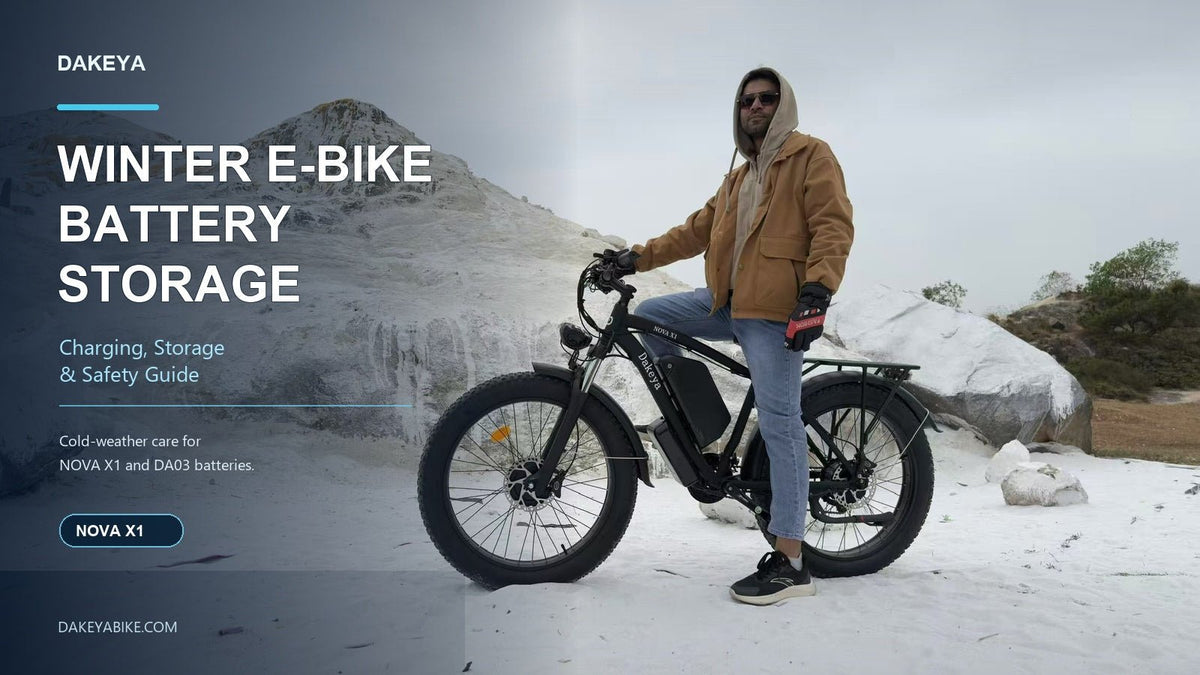
Short answer for NOVA X1 and DA03 owners: For winter storage, follow the instructions supplied with your exact bike and battery, keep the removable 60V 25Ah battery in a dry and temperature-stable location away from heat and combustible materials, use only the charger supplied or approved for the model, and do not leave the battery fully discharged for an extended period. Never charge while sleeping or when nobody is home.
Cold weather can temporarily reduce the energy an e-bike battery can deliver, which is why winter range may feel shorter. The bigger avoidable risks are charging a battery outside its manufacturer-approved temperature range, storing it while depleted, exposing it to moisture or physical damage, and using an incompatible charger. This guide is written primarily for Dakeya NOVA X1 and Dakeya DA03 owners.

Does Cold Weather Damage an E-Bike Battery?
Most modern e-bikes use lithium-ion battery packs. In cold conditions, the chemical processes inside the cells slow down, so the battery may deliver less usable energy than it does in mild weather. Riders often notice reduced range or a faster drop on the display. That temporary change does not automatically mean the battery has suffered permanent damage.
However, prolonged exposure to extreme temperatures, long-term storage at a very low state of charge, moisture, impact damage, and incorrect charging can affect safety and battery life. There is no responsible universal percentage for winter range loss because results depend on battery chemistry, temperature, battery age, terrain, tire pressure, rider weight, speed, and assist level.
If you are deciding whether a battery is approaching the end of its useful life, see our guide to e-bike battery range, lifespan, and replacement.
Should You Remove the Battery From Your E-Bike in Winter?
If your e-bike has a removable battery and the bike will be parked outside or in an unheated, damp, or highly variable environment, bringing the battery to a dry, secure, temperature-stable location is usually the more practical approach. Check the owner's manual first because the acceptable storage conditions differ by battery system.
- Outdoor parking: remove the battery when the design and manufacturer instructions allow it. Protect the open battery contacts from dirt and moisture without shorting them.
- Unheated garage or shed: do not assume the space is suitable. Consider its actual temperature swings, condensation, moisture, and fire-safety conditions.
- Indoor storage: choose a stable location away from direct sunlight, heaters, exits, combustible materials, children, and pets.
- Non-removable battery: move the whole bike to a suitable environment when possible and follow the model-specific manual.
Store the battery where it cannot fall, be crushed, have its terminals bridged by metal objects, or be exposed to water. Do not cover a battery in a way that traps heat during charging.
Can You Charge an E-Bike Battery When It Is Cold?
Do not guess. A battery brought in from freezing weather should be allowed to return naturally to the charging conditions permitted by its manufacturer before charging. If condensation is present, wait until the battery and connections are completely dry. Do not use a hair dryer, space heater, open flame, oven, or other rapid-heating method.
The U.S. Consumer Product Safety Commission advises riders to follow manufacturer instructions, remain present while charging, never charge while sleeping or away from home, and use only the charger supplied with or recommended by the device manufacturer. A plug that fits is not proof that a charger is electrically or thermally compatible.
Safe charging rule: Use the approved charger on a dry, stable surface, remain nearby, and unplug when charging is complete. Stop if the battery, charger, cable, or connector behaves abnormally.

Winter E-Bike Battery Storage Checklist
- Read the model-specific instructions. Confirm the manufacturer's storage-temperature and state-of-charge guidance for your battery.
- Inspect the battery. Look for cracks, swelling, loose parts, corrosion, damaged terminals, damaged wiring, or signs of water entry.
- Use the correct charger. Use the original charger or a replacement specifically approved for the battery and bike system.
- Avoid prolonged deep discharge. Prepare the battery to the storage level specified in its manual rather than leaving it empty for months.
- Power the system down. Turn the bike off and remove the key where applicable before removing or storing the battery.
- Choose a dry, stable location. Keep the battery away from sunlight, heaters, flames, flammable materials, and places where it may be struck or dropped.
- Check it periodically. Follow the manual's interval and make sure the battery has not become depleted or developed warning signs.
- Never open or rebuild the pack yourself. Battery repair and cell replacement require appropriate technical expertise and equipment.


How Often Should You Check a Stored Battery?
Use the interval in the battery or bicycle manual. Check the charge indicator periodically and avoid allowing the pack to remain deeply discharged. A universal calendar cannot account for every battery management system, cell type, storage temperature, or self-discharge rate.
If the battery does not behave as described in the manual, shows an error, will not accept a charge, or loses charge unusually quickly, stop troubleshooting by trial and error. Contact the manufacturer or a qualified e-bike service provider. Dakeya owners can also consult the user manuals and installation guides.
Prepare the Rest of the E-Bike for Winter Storage
Battery care is only part of winterizing an e-bike. Before long-term storage:
- Clean the frame and drivetrain, then let the bike dry completely.
- Check tire condition and set pressure according to the tire and bike guidance.
- Inspect brake pads, rotors, cables, hydraulic lines, lights, and fasteners.
- Lubricate the chain with an appropriate bicycle lubricant and wipe away excess.
- Store the bike securely so tires, controls, and wiring are not damaged.
- Before the first ride after storage, perform a complete safety check at low speed.
Fat tires can improve flotation and stability on some loose surfaces, but they do not eliminate the risk of slipping on snow or ice. Surface conditions, tire selection, pressure, speed, and rider technique still matter. Read more in our guide to riding a fat-tire e-bike on snow, sand, and mud.
Bringing a Stored Battery Back Into Service
Do not treat the first spring ride as a normal departure. Start by inspecting the battery case, mount, electrical contacts, charge port, charger cable, and frame wiring. Confirm that the battery locks securely into place and that no dirt, corrosion, or foreign object is interfering with the connection. If the battery was stored separately, install it only after both the battery and bicycle are dry and within the operating conditions stated in the manual.
Charge the battery with its approved charger while you are present. Watch for warning lights, unusual heat, odors, noises, or an unexpectedly interrupted charge. If anything seems abnormal, disconnect power only when it is safe to do so and ask the manufacturer or a qualified technician for guidance. Do not repeatedly reconnect a battery that shows an error in the hope that the fault will clear.
Before riding, check the display, lights, brakes, throttle or pedal-assist response, tire pressure, and battery retention mechanism. Begin with a short, low-speed test in a controlled area. A battery indicator may need a normal ride or charge cycle to provide a useful estimate after long storage, but it should not be ignored if it drops abruptly or the system shuts down under modest load.
Warning Signs: Do Not Charge or Use the Battery
Stop using and charging the battery if you notice any of the following:
- swelling, bulging, cracking, or a deformed case;
- unusual heat when the battery is idle or during normal use;
- smoke, hissing, popping, leaking, or an unusual odor;
- damaged terminals, wiring, charge port, mounting rail, or lock;
- water entry, severe impact, or evidence the pack was crushed;
- repeated charger or battery-management errors.
Move people away from immediate danger and contact emergency services if there is smoke, fire, or an escalating thermal event. Do not handle a hot, smoking, or burning lithium-ion battery. For a damaged but stable battery, contact the manufacturer or a qualified service provider for next steps. Do not place lithium-ion batteries in household trash or ordinary recycling.
NOVA X1 and DA03 Battery Compatibility: Check More Than Voltage
The two current priority Dakeya models both use removable 60V 25Ah batteries, but that shared headline specification does not make every battery pack interchangeable.
| Priority model | Publicly listed battery specification | What to verify |
|---|---|---|
| NOVA X1 | 60V 25Ah removable battery | Exact model, connector, rail, case, lock position, BMS requirements, and charger |
| DA03 | 60V 25Ah removable battery | Exact model, connector, rail, case, lock position, BMS requirements, and charger |
Voltage and amp-hours alone do not prove compatibility. Before ordering a replacement e-bike battery, verify the exact model, voltage, connector, mounting rail, case dimensions, lock position, battery-management requirements, and charger. If you need a replacement charger, choose the correct model-specific option from our e-bike battery chargers.

Frequently Asked Questions
Can I leave an e-bike battery in an unheated garage?
Only if the actual temperature, moisture, and storage conditions meet the manufacturer's requirements. Garages vary widely. If the battery is removable and the garage is cold, damp, or subject to large temperature swings, a dry and more temperature-stable location is generally the safer choice.
Should I fully charge my e-bike battery before winter?
Do not apply one rule to every battery. Prepare it to the storage state of charge specified by the battery or bike manufacturer. The important general point is to avoid leaving it deeply discharged for a prolonged period.
Why does my e-bike have less range in cold weather?
Cold temperatures temporarily slow the battery's electrochemical processes, reducing usable energy and power. Tire pressure, denser air, wind, heavier clothing, road conditions, and increased rolling resistance can further reduce range.
Can I use a universal e-bike charger?
Not unless the battery or device manufacturer has specifically approved it. A matching connector is not enough. Output voltage, current, communication, polarity, and charge profile must all be compatible.
What should I do if the battery gets wet?
Turn the bike off, do not charge the battery, and follow the manufacturer instructions. If water entered the case or the battery was submerged, contact the manufacturer or a qualified service provider rather than opening the pack yourself.
Can I ride a fat-tire e-bike on snow or ice?
Some fat-tire e-bikes can provide better flotation on soft snow, but no tire guarantees grip on ice. Check local rules, use suitable tires and protective equipment, slow down, and avoid riding when conditions exceed your experience or equipment.
Final Takeaway
Good winter battery care is conservative and model-specific: keep the battery dry and protected, follow its approved temperature and charge guidance, use only a manufacturer-approved charger, remain present while charging, avoid prolonged deep discharge, and stop immediately if the pack shows damage or abnormal behavior.
For compatible bikes, batteries, and chargers, browse Dakeya electric bikes, fat-tire e-bikes, and model-specific replacement parts.
Sources and Safety References
- U.S. Consumer Product Safety Commission: Micromobility Information Center
- Dakeya user manuals and installation guides
This article provides general educational information. The instructions supplied with your specific e-bike, battery, and charger take priority.


Share:
Dakeya NOVA X1 vs. DA03: Which Dual-Motor Fat-Tire E-Bike Is Right for You?