
Quick answer: A matching voltage label or connector does not prove battery compatibility. Obtain manufacturer confirmation for the complete battery, charger, controller and mounting system before buying a replacement or attempting electrical work.
A replacement e-bike battery is compatible only when the complete electrical and physical system matches. The label “48V” is a starting point—not proof of fit. Before ordering, verify nominal voltage, charger voltage, controller current, connector and polarity, mounting rail, dimensions, discharge capability and documentation. A battery that slides into the frame but does not match the controller or wiring can damage equipment or create a fire risk.

Start with the original battery label
Photograph the battery label before removing anything. Record the manufacturer, model, nominal voltage, capacity in amp-hours (Ah), energy in watt-hours (Wh), charge-limit voltage and any maximum or continuous discharge rating. Also photograph the charger label and controller label. If a specification is missing or unreadable, ask the bike manufacturer or a qualified e-bike technician rather than estimating.
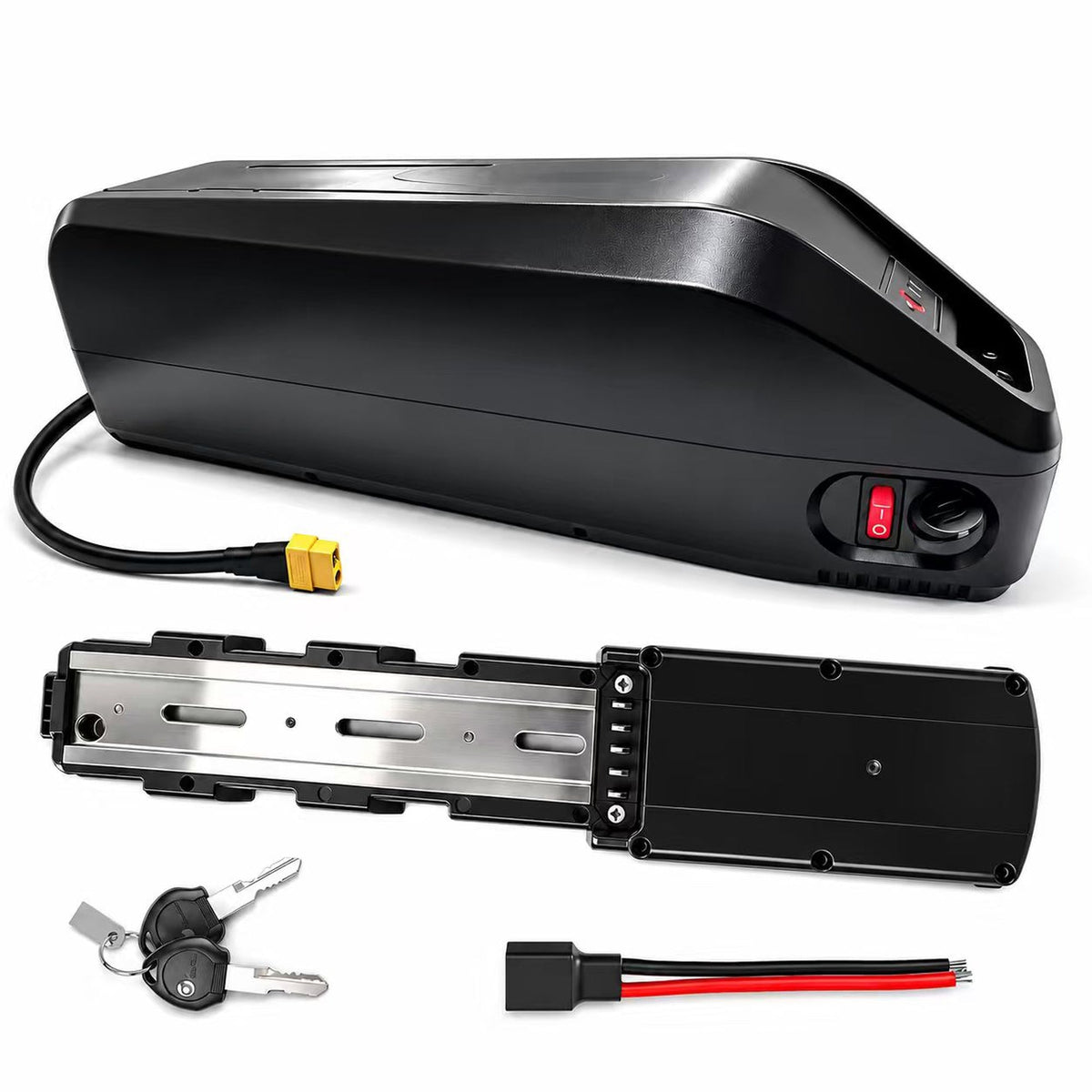
Capacity affects available energy, but it does not establish compatibility. For example, the current Dakeya 48V 15Ah Hailong-style battery is listed at 720Wh and uses a 25A continuous-discharge BMS. Those numbers must be checked against the particular bike and controller; they are not an invitation to install it on every 48V e-bike.
1. Match nominal voltage and full-charge voltage
The replacement battery’s nominal voltage must match the system specified by the manufacturer. A typical 48V lithium-ion pack may use a 54.6V charge limit, but always follow the labels for the exact pack. Never substitute a 36V, 52V or 60V battery because the case or connector appears similar. The controller, display, motor system and low-voltage protection were designed around a particular voltage range.
The charger must also match the battery chemistry and charge-limit voltage. The U.S. Consumer Product Safety Commission advises consumers to use only the supplied charger or a replacement approved by the product manufacturer and to be present while charging. Review the CPSC’s micromobility battery safety guidance before charging a replacement pack.
2. Check controller current against the battery BMS
Voltage alone does not tell you whether a battery can safely supply the controller. Find the controller’s rated and maximum current. The battery management system’s continuous-discharge rating must support the application specified by the manufacturer. If the controller can demand more current than the pack is designed to provide, protection may trip, wiring may overheat, performance may be unreliable or components may be damaged.
Do not infer suitability from motor wattage alone. Advertised motor power may be nominal, maximum or combined peak output, while controller current determines electrical demand more directly. For the Dakeya 48V 15Ah battery, the live page recommends use up to 1000W only when controller current and the rest of the system are compatible. Treat that as a compatibility ceiling with conditions—not a universal promise.

3. Verify connector type, pinout and polarity
Two plugs can look alike while using different pin assignments. Record the battery-to-base interface, discharge connector, charging connector and wire colors, but never assume color alone proves polarity. A qualified installer should verify positive and negative with appropriate instruments before energizing the system.
The Dakeya Hailong-style pack currently lists a five-pin blade connection between battery and base, a DC5521 charge port and an XT60 adapter cable with bare leads. That combination will not automatically match an existing cradle or controller. Splicing, changing connectors or bypassing the original base can invalidate coverage and introduce poor connections. Do not improvise if the exact wiring plan is not documented.
4. Measure the case, rail and removal path
“Hailong-style” batteries come in multiple shells and rails. Measure the pack length, width and height, then measure the frame triangle and the space needed to slide the battery on and off its base. Check bottle-boss spacing, bolt size, cable clearance and whether the lock can turn. Compress the suspension carefully, where applicable, to confirm the tire or linkage cannot contact the battery.
The current 48V 15Ah battery page lists approximate dimensions of 395.3 × 105.6 × 95mm (15.56 × 4.16 × 3.74in). Print or make a cardboard template at full size, add clearance for the rail and key, and test the removal direction before buying.

5. Confirm the charger separately
A charging plug that fits is not evidence that a charger is correct. Compare output voltage, current, polarity, connector and battery chemistry. The battery discussed here requires a compatible 54.6V lithium-ion charger and is sold without one. Dakeya’s battery charger page shows available accessories, but buyers should still obtain model-specific confirmation before pairing a charger and battery.
Charge on a stable, dry surface away from exits and combustible materials. Do not charge while sleeping or when nobody is present. Stop using a pack that swells, leaks, smells unusual, becomes abnormally hot, makes noise or shows crash or water damage. New York City’s FDNY provides a clear public lithium-ion battery safety checklist that is useful wherever you live.
6. Understand what safety documents mean
Ask for the exact model number on every certificate or report. UN 38.3 concerns transport testing for lithium batteries; it is not a complete consumer-product safety certification. UL 2271 addresses batteries for light electric vehicles, while UL 2849 covers the electrical system of an e-bike. A component recognition, battery listing and complete-system certification are not interchangeable.
UL Solutions explains the distinction through its UL 2849 e-bike certification overview. The Dakeya battery page says documentation is available for model verification and explicitly does not represent the product as UL Listed or the bike as UL 2849 certified. Preserve that precise wording when comparing options.
7. Plan installation and the first test
- Power the bike off and remove the original battery according to its manual.
- Inspect the frame, rail, terminals and wiring for heat, corrosion, looseness or impact damage.
- Have a qualified installer mount the correct base and verify polarity.
- Secure wiring away from steering, tires, chain, cranks and suspension.
- With the drive wheel safely clear, power on and check the display for errors.
- Test assistance and braking at low speed in a controlled area.
- After a short ride, power off and inspect connectors for movement or abnormal heat.
If your bike is a Dakeya model, use its exact product documentation rather than assuming the general replacement battery fits. Current owners can review the NOVA X1 product page, DA03 product page and the battery winter-storage guide. Contact support with the bike model, serial number and clear label photos before ordering a replacement.
Replacement battery checklist
- Exact bike, original battery and controller model recorded
- Nominal and charge-limit voltage match
- Battery continuous current supports the controller
- Chemistry and charger output match
- Connector, pinout and polarity verified
- Case, rail, mounting holes and removal clearance measured
- Documentation applies to the exact battery model
- Shipping destination accepts the lithium battery
- Installation and first test plan confirmed
Frequently asked questions
Can I replace a 48V battery with any other 48V battery?
No. Current capability, charge voltage, connectors, polarity, communication, mounting and dimensions may differ.
Can I use a higher-Ah battery?
Possibly, but only if voltage, current capability, charger, electronics, physical fit and manufacturer requirements all match. Higher Ah mainly indicates more nominal capacity; it does not solve an incompatibility.
Can I reuse my old charger?
Only when its output voltage, chemistry, current, connector and polarity are approved for the exact replacement battery. A fitting plug is not enough.
Final takeaway
Buy a replacement e-bike battery from a specification sheet, not a product photo. Match the whole system, measure twice and obtain model-specific confirmation. That work protects the bike, the battery and the place where you charge it.


Share:
How to Lock an E-Bike: Theft Prevention for High-Value Bikes