
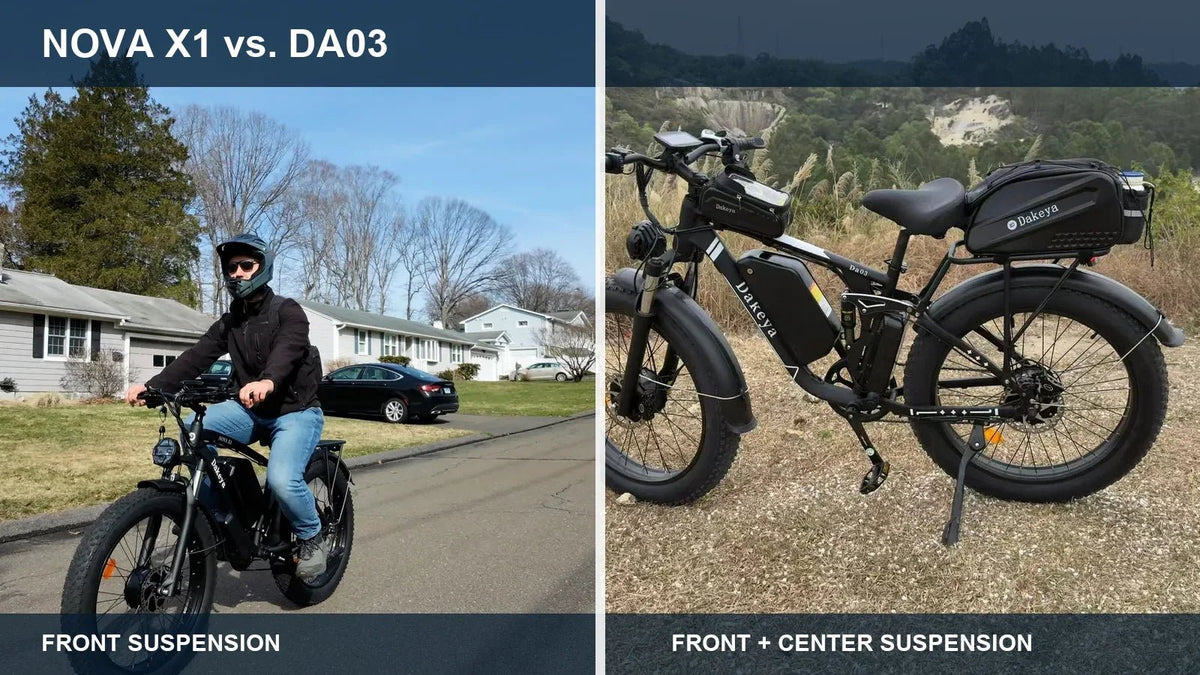
Suspension changes how an electric bike feels long before it changes a specification sheet. On broken pavement, gravel, hard-packed trails and long rides, the difference between a front-suspension e-bike and a bike with front plus center suspension affects comfort, control, weight transfer and how much feedback reaches the rider.
The Dakeya NOVA X1 and Dakeya DA03 make that choice easy to understand. Both are high-performance dual-motor fat-tire e-bikes aimed at riders who want more capability than a basic commuter. The NOVA X1 uses front suspension and emphasizes direct handling and higher combined peak power. The DA03 adds a center shock, giving riders another layer of isolation from repeated bumps.
Quick answer: choose the NOVA X1 if you prioritize stronger peak performance, a more direct frame feel and mainly ride smoother roads or maintained trails. Choose the DA03 if your routes contain repeated bumps, rougher surfaces or longer stretches where comfort and rear-end compliance matter more.

NOVA X1 vs. DA03 at a glance
| Decision factor | NOVA X1 | DA03 |
|---|---|---|
| Suspension layout | Front suspension | Front suspension plus center shock |
| Motor system | Dual 3000W peak motors; 6000W combined peak | 2500W front + 3000W rear peak; 5500W combined peak |
| Top-speed claim | Up to 50 MPH under stated test conditions | Up to 48 MPH under controlled test conditions |
| Tires | 26 × 4.0-inch all-terrain fat tires | 26 × 4.0-inch fat tires |
| Brakes | Hydraulic disc brakes | Hydraulic disc brakes |
| Best fit | Performance-focused riding on pavement and maintained mixed surfaces | Rougher routes, repeated bumps and riders prioritizing comfort |
| Current price before code* | $1,499 | $1,399 |
| Current offer* | BF100OFF brings it to $1,399 + free rear rack bag | BF100OFF brings it to $1,299 + free rear rack bag |
*Prices and promotions checked October 8, 2026 and may change. Confirm the product page before ordering.
What front suspension actually does
A suspension fork allows the front wheel to move upward when it hits a bump. That movement can reduce the sharp impact transferred through the handlebar, help the tire follow uneven ground and improve steering confidence when the surface is not perfectly smooth.
Front suspension is especially noticeable when the front wheel reaches pothole edges, gravel transitions, roots or broken pavement. It does not isolate the entire rider from the road: the rear wheel is still connected to the main frame, so impacts at the back of the bike can travel through the saddle and frame.
The NOVA X1 uses this more direct arrangement. Riders who value predictable frame feedback, simpler suspension hardware and performance on reasonably maintained surfaces may prefer it.

What the DA03 center shock adds
The DA03 combines its front fork with a center shock in the frame. When the rear wheel encounters a bump, the rear section can move relative to the front frame instead of passing every impact directly to the saddle. On repeated chatter or uneven ground, that can reduce fatigue and help the rear tire maintain contact.
That does not mean every bump disappears. Suspension performance depends on shock setup, rider and cargo weight, speed, tire pressure and terrain. A center shock also adds moving parts that should be inspected for looseness, wear and correct fastener torque.

Comfort: which one feels smoother?
On the same rough route, the DA03 should provide more isolation because both ends of the bike can respond to impacts. This is most useful when bumps arrive repeatedly rather than as a single isolated hit.
- DA03 advantage: washboard paths, broken pavement, gravel connectors and longer rough rides.
- NOVA X1 advantage: riders who prefer a direct feel and spend more time on pavement or smoother mixed routes.
Comfort is not created by suspension alone. Saddle shape, riding posture, tire pressure, rider weight, speed and how strongly the rider grips the bars all matter. Lowering tire pressure may improve comfort and traction, but going below the tire or manufacturer limits can damage the rim, increase puncture risk and reduce stability.
Handling and weight transfer
More suspension movement can improve composure over uneven surfaces, but it can also change how the bike reacts under acceleration, braking and cornering. A center shock may compress as weight shifts, so riders should learn the DA03 gradually before using high power.
The NOVA X1 has less rear-frame movement, which can feel more immediate on smooth surfaces. The DA03 can feel more settled over repeated bumps. Neither layout replaces rider technique: enter rough sections at a sensible speed, keep a relaxed grip and avoid sudden throttle, steering or braking inputs.

Power: do not choose on wattage alone
The NOVA X1 lists 6000W combined peak power, while the DA03 lists 5500W combined peak power. Peak figures describe short-duration system capability, not continuous output in every condition. Controller tuning, battery state, temperature, traction, total load and terrain affect actual performance.
The 500W difference should not be the only buying criterion. If your ride is dominated by rough ground, the DA03 suspension layout may matter more than the higher NOVA X1 peak figure. If your routes are smoother and you want the strongest performance emphasis, the NOVA X1 may be the better fit.
Braking matters as much as acceleration
Both models use hydraulic disc brakes. High-performance e-bikes are heavy and can build speed quickly, so braking setup and maintenance deserve as much attention as motor output.
- Bed in new brake pads according to the manual.
- Inspect pads, rotors and hydraulic feel regularly.
- Increase stopping distance in rain, loose gravel or when carrying cargo.
- Brake before a corner rather than making an abrupt input while turning.
- Use protective equipment and practice in a clear, permitted area.
Cargo and everyday practicality
Both current offers include a free rear rack bag, but cargo changes handling. Added rear weight can increase stopping distance, reduce range and alter suspension response. On the DA03, cargo and rider weight also influence how much the center shock compresses.

Keep heavy items low and centered, secure straps away from the wheel and check rack hardware before every ride. Do not assume a bag, rack or suspension component can carry unlimited weight.
Which model fits your route?
Choose the NOVA X1 if:
- You want the higher combined peak-power specification.
- Your normal routes are pavement, maintained trails or smoother mixed surfaces.
- You prefer more direct frame feedback.
- You want the performance-focused option and accept that local high-power e-bike rules vary.
Choose the DA03 if:
- Your routes include repeated bumps, rough pavement or gravel.
- Reducing rear-end impact and rider fatigue is a priority.
- You want front plus center suspension at the lower current price.
- You expect longer rides where comfort matters more than the final peak-power number.
Before you buy: five checks
- Map your real route. Note hills, surface changes and how much rough terrain you actually ride.
- Check local rules. These are high-performance models and may not qualify as ordinary street-legal e-bikes everywhere.
- Plan storage and transport. Confirm doorway, rack and lifting requirements before ordering.
- Review shipping and returns. Eligible continental U.S. orders receive free standard shipping; conditions apply to the 30-day return policy.
- Budget for safety gear and maintenance. Helmet, visibility equipment, tire care and brake inspection are part of ownership.
Final recommendation
The NOVA X1 and DA03 are not simply “more power” and “less power.” They solve different rider priorities. The NOVA X1 is the stronger choice for performance-focused riders on smoother routes. The DA03 is the more comfort-oriented choice for repeated bumps and mixed surfaces because of its center shock.
If you are still deciding, start with the route you ride most often—not the biggest number on the page. That decision will usually point to the right suspension layout.
Current Dakeya offer
Both NOVA X1 and DA03 currently include a free rear rack bag. Use code BF100OFF for an extra $100 off. Confirm current pricing and availability on each product page.
Safety note: Performance, speed and range vary with rider and cargo weight, terrain, temperature, tire pressure, battery condition and riding style. Always follow the manual, wear appropriate protective equipment and comply with local laws.


Share:
Dual-Motor vs. Single-Motor E-Bikes: Which One Do You Actually Need?