
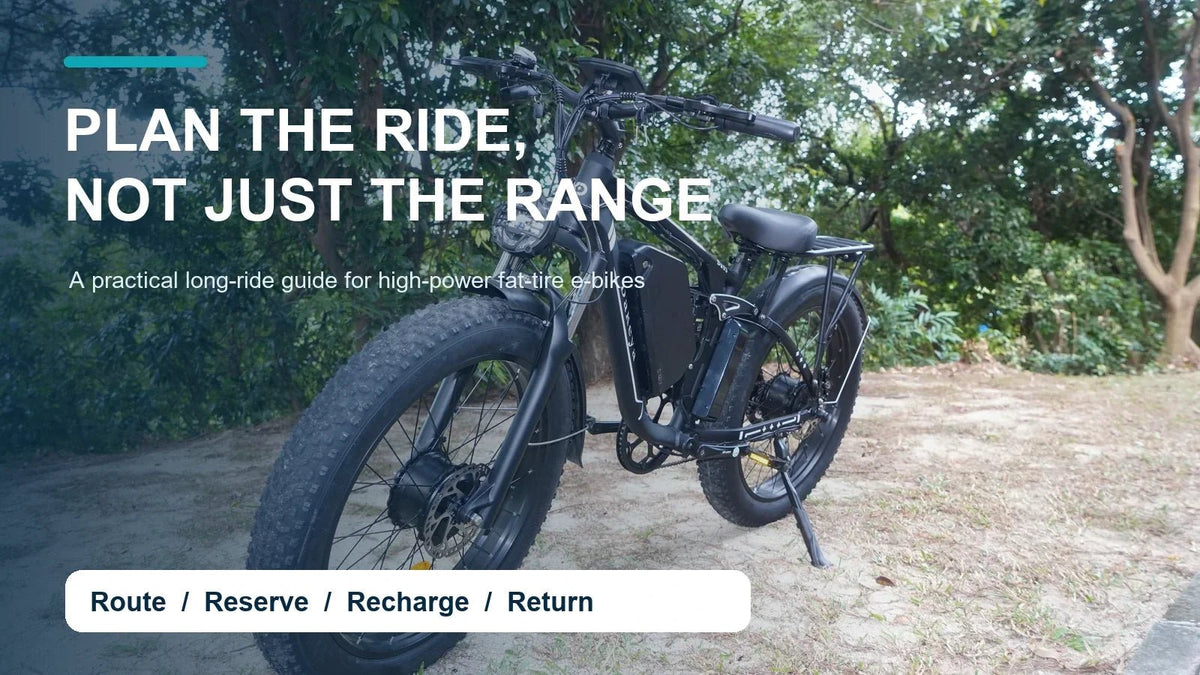
A long electric-bike ride should be planned around what gets you home—not the largest range number printed on a product page. Speed, hills, wind, temperature, tire pressure, rider and cargo weight, surface conditions, stops and drive mode can all change how quickly a battery is used.
This guide gives riders a practical system for planning longer trips on high-power fat-tire e-bikes. It is especially relevant to riders considering the Dakeya NOVA X1 or Dakeya DA03, but the same method applies to many electric bikes: begin conservatively, keep a return reserve, collect your own repeatable ride data and adjust only after several comparable trips.
Table of contents
- Why real-world e-bike range varies
- The return-margin rule
- How to evaluate a route before leaving
- Single- versus dual-motor use
- Build your own range log
- NOVA X1 and DA03 planning priorities
- Frequently asked questions

Why real-world e-bike range varies
A battery stores a fixed amount of energy, but a ride does not demand energy at a fixed rate. Two riders using the same bike can finish the same distance with very different battery readings. Even one rider can see different results on the same route when weather, load or speed changes.
1. Speed and acceleration
Higher speed increases aerodynamic drag, while repeated hard acceleration asks the system to deliver more power. A route with frequent stops can use more energy than a steady ride of the same distance. Smooth starts and a moderate cruising speed usually make trip planning more predictable.
2. Hills and surface conditions
Climbing requires work against gravity. Soft grass, deep gravel, sand, mud and rough trails add rolling resistance compared with firm pavement. A ten-mile route is therefore not a complete description: ten flat paved miles and ten hilly mixed-surface miles are different energy tasks.
3. Rider, cargo and accessories
The motor must move the total system weight: bike, rider, clothing, locks, tools, bags and cargo. Added weight matters most during climbing and acceleration. Large bags and upright riding positions can also increase wind resistance.
4. Temperature
Cold conditions can temporarily reduce available battery performance. A route that feels comfortable in mild weather may require a larger reserve on a cold day. Store and charge the battery according to the manual, and never try to heat a cold battery with an external heater or open flame.
5. Tire pressure and mechanical condition
Underinflated tires increase rolling resistance. Overinflating beyond the tire or bike limits is not a safe range strategy. Use pressure within the published limits and choose it for the actual load and surface. Brake drag, poor wheel alignment and neglected bearings can also waste energy.
6. Drive and assist mode
Using both motors generally consumes energy faster than using one motor under comparable riding conditions. Throttle-heavy riding can also change consumption compared with steady pedal assist. High output is useful when conditions demand it, but it should not be treated as free range.

Use the return-margin rule
The safest planning question is not “How far can this bike go?” It is “How much battery should remain when I turn toward home?” For an unfamiliar route, a useful starting point is to protect roughly 25–35% of the displayed battery as a reserve. This is a planning margin—not a guaranteed emergency range.
Why keep that much? The return leg may have a headwind, more climbing, colder temperatures or a softer surface. A battery display may also move in steps rather than reporting perfectly linear energy use. A reserve gives you time to slow down, select a lower-power mode or shorten the route before the situation becomes urgent.
A simple first-ride method
- Begin fully prepared. Confirm charge, tire condition, brake function, weather and route access before leaving.
- Set a conservative turnaround point. Make the first test shorter than your hoped-for maximum trip.
- Check at halfway. Compare distance completed with battery used. If you have used more than half of the energy you are willing to spend, turn back early.
- Reduce demand if needed. Slow down, use one motor where appropriate, pedal more and avoid unnecessary hard starts.
- Record the result. Note distance, route, temperature, load, drive mode and battery remaining.

Evaluate the route before leaving
Digital maps are useful, but distance alone is not enough. Review elevation, surface type, legal access, traffic exposure, expected wind, temperature and available exit points. Check the local forecast through the National Weather Service before leaving. If a trail closes or weather changes, you need a shorter path home.
Route-planning checklist
- Is the route permitted for the exact vehicle configuration?
- How much climbing occurs on the outbound and return legs?
- Which sections are pavement, hard-packed trail, grass, gravel or loose ground?
- Is there a safe turnaround point before the planned destination?
- Are there alternate routes if weather, traffic or trail conditions change?
- Will you have reliable phone service, identification and an emergency contact?
- Is any charging stop genuinely compatible, permitted and long enough to be useful?
Do not assume that an available outlet makes public charging appropriate. Use only the correct charger for the battery, obtain permission, keep equipment dry and never leave a charging system where it blocks a walkway or creates a trip hazard.
Prepare the bike, rider and cargo
Longer distance magnifies small problems. Before leaving, inspect tire condition and pressure, brake response, wheel security, steering, lights, battery mounting and visible cables. These checks align with the U.S. Consumer Product Safety Commission’s micromobility safety guidance. Secure every bag so straps cannot enter the wheel, brake rotor or drivetrain.
Carry only tools and spares you know how to use. Depending on the route, that may include an appropriately sized tube or repair kit, tire pump, basic tools, water, identification and weather protection. A heavy collection of unnecessary equipment also becomes part of the load the bike must move.
Wear suitable protective equipment and visible clothing. High-performance models can build speed quickly; use conservative settings while learning the bike. The NHTSA bicycle safety resource explains why roadway visibility, infrastructure and riding conditions matter. E-bike classifications and permitted riding locations vary by state, so review the PeopleForBikes state-by-state e-bike law guide and confirm current local rules before riding.
Plan motor use, not just motor availability
Dual-motor capability can help on steep grades, loose approaches and demanding acceleration, but continuous use is not always the best range strategy. On easier sections, a rider may choose a lower assist level or single-motor mode where the bike and conditions allow it. On demanding sections, the extra traction or power may be worth the higher energy use.
A practical approach is to reserve the highest-demand mode for situations that need it rather than using it automatically for the entire trip. The goal is not to avoid the bike’s capability; it is to use that capability intentionally.
| Ride condition | Planning approach | Why |
|---|---|---|
| Flat, firm surface | Use a moderate speed and conservative assist | Creates more predictable consumption. |
| Long climb | Reduce unnecessary speed and watch battery use | Climbing increases energy demand. |
| Loose or rough section | Use the traction and power needed for control | Stability matters more than chasing a range number. |
| Unexpected headwind | Slow down and protect the return reserve | Aerodynamic demand rises quickly with speed. |
| Battery use is ahead of plan | Turn back early or choose a shorter route | The reserve should remain a reserve. |
Build your own range log
Your most useful range estimate comes from your own repeatable rides. Record at least three trips with similar starting charge, tire pressure and load. A phone note or spreadsheet is enough.
- date and route;
- distance and elevation;
- temperature and wind;
- rider plus cargo load;
- single- or dual-motor use;
- assist level or throttle pattern;
- surface mix;
- battery indication at the finish.
Do not turn one good ride into a promise for every ride. Look for a conservative pattern. If three similar trips finish with different readings, plan around the lowest result until you understand why.

NOVA X1 and DA03: different priorities, same planning discipline
The current NOVA X1 and DA03 are both high-performance 60V fat-tire models. Their product pages list conditional maximum-range figures, but those figures should not become a personal turnaround rule.
The NOVA X1 emphasizes higher combined peak output and a front-suspension layout. The DA03 combines front and center suspension, which can be a useful comfort priority on repeated bumps and rough connectors. Either model still requires a conservative reserve, legal route choice and pre-ride inspection.
For a deeper model decision, read the NOVA X1 vs. DA03 suspension comparison. If you are preparing your home and storage before delivery, use the 60V e-bike pre-purchase checklist.
What to do if the battery drops faster than expected
- Slow down smoothly and avoid repeated hard acceleration.
- Select a lower-demand mode where safe and appropriate.
- Pedal steadily rather than waiting until the battery is almost empty.
- Choose the shortest permitted route home.
- Avoid detours, unnecessary stops and additional climbing.
- Contact someone early if you may not complete the route safely.
If consumption changes sharply compared with similar rides, inspect tire pressure, brake drag, load, temperature and battery mounting. Stop using equipment that is damaged, unusually hot, swollen, leaking or producing an unusual odor, and contact qualified service.
Frequently asked questions
Can I trust the maximum range on a product page?
Treat it as a conditional reference, not a guaranteed trip distance. Test conditions, speed, rider weight, terrain, weather, tire pressure and drive mode all affect the outcome.
Is a 25–35% reserve always enough?
No fixed percentage guarantees a return. It is a conservative starting margin for unfamiliar rides. Increase it for cold weather, strong wind, climbing, soft terrain, heavy load or an aging battery.
Does dual-motor mode always cut range in half?
No. Consumption depends on how much power the system actually uses and for how long. Under comparable conditions, using both motors generally uses energy faster, but there is no universal “half-range” rule.
Should I carry the charger?
Only when you have a permitted, dry and genuinely useful charging stop and can transport the charger safely. Carrying it does not replace a return reserve.
What is the best way to improve my personal estimate?
Repeat a familiar route several times and log distance, conditions, mode and battery remaining. Use the lowest comparable result for planning rather than the best result.
Final takeaway
Reliable long-distance riding is not about finding one perfect mileage number. It comes from a conservative turnaround rule, a protected return reserve, deliberate motor use, a well-maintained bike and your own ride history.
Start shorter than you think you can ride. Return with energy left. Record the result. That process builds genuine range confidence without turning a conditional estimate into a risky promise.
Compare the current Dakeya models
Check live product pages for current specifications, price, availability and promotion terms before ordering.
Safety note: Follow the owner’s manual, use appropriate protective equipment and comply with local laws. Range varies with rider and cargo weight, route, speed, weather, temperature, tire pressure, battery condition and riding mode.


Share:
60V E-Bike Pre-Purchase Checklist: Storage, Charging & Fit