
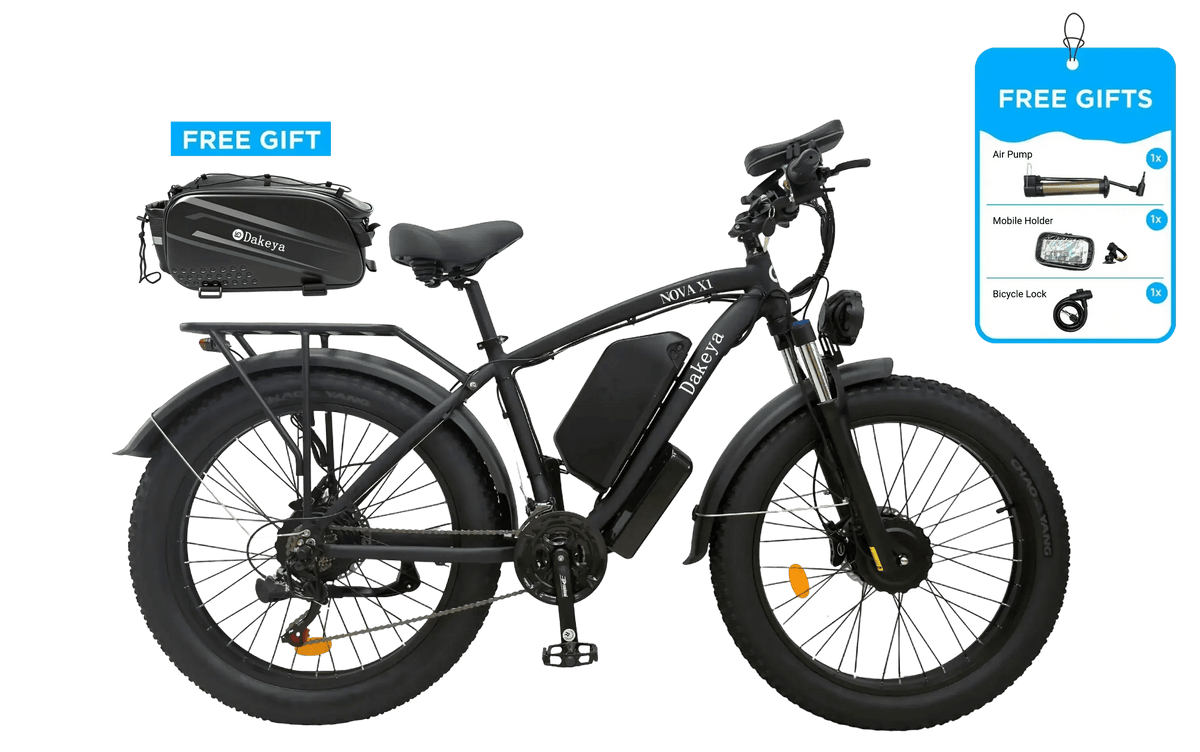
A 60V fat-tire e-bike is a serious purchase, and the best time to think about ownership is before the delivery truck arrives. Buyers often compare motor output, speed and range, then discover later that charging space, door width, storage, lifting and local riding rules matter just as much.
This pre-purchase checklist is written for riders considering the Dakeya NOVA X1 or Dakeya DA03. Both current models use a 60V 25Ah battery, 26-inch fat tires, hydraulic disc brakes, adjustable front suspension and selectable single- or dual-drive operation. The DA03 also adds a center shock. The questions below help you decide whether your home, route and routine are ready for either bike.
Table of contents
- Verified ownership facts
- Charging space and outlet planning
- Storage, doors and security
- Weight, lifting and transport
- Route and model choice
- Delivery-day preparation
- Frequently asked questions

Verified facts that affect ownership
| Ownership factor | NOVA X1 | DA03 | Why it matters at home |
|---|---|---|---|
| Battery | 60V 25Ah | 60V 25Ah | Plan a stable, dry charging location with the supplied charger. |
| Charger | 60V 2.5A | 60V 2.5A | A full charge is planned at about 12 hours under the confirmed current configuration. |
| Wheel format | 26-inch fat tire | 26-inch fat tire | The bike needs more floor and turning space than a compact commuter. |
| Suspension | Adjustable front suspension | Adjustable front plus center suspension | Choose according to route comfort, not storage convenience alone. |
| Bike weight | 39 kg / about 86 lb | 41 kg / about 90 lb | Regular stair carrying is impractical for many owners. |
| Brakes | Front and rear hydraulic disc brakes | Front and rear hydraulic disc brakes | Keep rotors clean and avoid leaning the bike against them. |
| Drive selection | Single or dual drive | Single or dual drive | Use conservative settings while learning the bike. |
These are planning facts, not promises that every trip will produce the same range or speed. Terrain, rider and cargo weight, temperature, tire pressure, battery condition and riding mode all change real-world performance.
1. Do you have the right charging space?
A good charging area is dry, ventilated, stable and away from combustible clutter. It should let the charger sit where its cable is not stretched, crushed or turned into a trip hazard. Do not cover the charger, place it on soft furnishings or expose the battery and charger to rain.
Use this charging checklist
- Use the charger supplied for the bike and battery configuration.
- Inspect the charger, plug, cable and battery port before connecting.
- Keep the bike and charger away from heaters, direct flame and standing water.
- Charge where an adult can notice unusual heat, odor, swelling or damage.
- Do not charge a battery that was damaged in shipping, dropped or visibly deformed.
- Let the system cool after a demanding ride before charging.
- Follow the manual’s connection order and unplug when charging is complete.
The confirmed 2.5A charger and 25Ah battery produce an estimated full-charge planning time of roughly 12 hours. Treat that as an overnight schedule rather than expecting a quick top-up immediately before every trip.

2. Measure the complete storage route
Measure more than the final parking spot. Start at the curb or driveway and follow the entire route: gate, doorway, hallway corner, elevator, garage aisle and bike stand. A wide handlebar or fat tire may pass through a doorway but still be difficult to turn in a narrow corridor.
Check these dimensions and obstacles:
- narrowest door, gate and elevator opening;
- tightest corner and available turning radius;
- floor length and handlebar clearance at the storage point;
- steps, thresholds or slopes along the route;
- access to the charging outlet without an unsafe extension-cord setup;
- space to inspect tires and brakes without blocking an exit.
A wall hook designed for a light bicycle is not automatically suitable for a roughly 86-90 lb electric bike. Use a floor stand or anchoring system with a clearly adequate capacity. Keep the hydraulic brake rotors away from oil, spray lubricant and accidental impacts.
3. Build a realistic security plan
High-value e-bikes attract attention. A key or electronic start function does not physically anchor a bike. For home storage, use a hardened lock through the frame and an immovable anchor. In shared garages, consider a second lock and choose a location with controlled access and visibility.
Record the serial number, photograph the bike and receipt, and confirm whether your home or renter’s insurance covers an e-bike of this value and performance category. Do not leave the battery key or spare keys with the bike.
4. Decide how you will move an 86-90 lb bike
The NOVA X1 is confirmed at 39 kg and the DA03 at 41 kg in the current configuration. That difference is small; neither should be treated like a lightweight city bicycle. If your home requires several flights of stairs, solve that problem before ordering.
Better options than routine stair carrying
- ground-floor garage or secure shed storage;
- a building elevator with measured doorway and floor space;
- a load-rated ramp for a short step or vehicle;
- two-person handling when lifting is unavoidable;
- a motorcycle-style or heavy e-bike hitch carrier with adequate bike and tongue-weight ratings.
Never assume an ordinary bicycle rack can support the bike. Check the rack’s per-bike rating, total rating, wheel-tray width, wheelbase compatibility and vehicle limits. Remove loose cargo before transport and follow the rack manufacturer’s instructions.
5. Match the bike to the route you will actually ride
If both bikes fit your home, the next decision is route comfort. The NOVA X1 has adjustable front suspension and weighs slightly less. The DA03 adds a center shock, which can reduce the amount of repeated bump energy reaching the rider on rough surfaces.
| Your priority | Better starting point | Reason |
|---|---|---|
| Smoother pavement and maintained mixed routes | NOVA X1 | Front suspension, slightly lower confirmed weight and a direct frame feel. |
| Broken pavement, repeated bumps or rough connectors | DA03 | Front plus center suspension adds another layer of compliance. |
| Long charging window available | Either | Both use the confirmed 60V 25Ah battery and 2.5A charger. |
| Frequent stair carrying | Neither is ideal | Both are heavy full-size fat-tire bikes. |
For the deeper ride-focused comparison, see the NOVA X1 vs. DA03 suspension guide. For current price and availability, use the live product pages rather than a saved screenshot.

6. Confirm where you can legally ride
The NOVA X1 and DA03 are high-performance models. They may not fit ordinary low-speed e-bike definitions in every state, city, trail system or public-road setting. Classification can affect permitted routes, equipment, age, licensing, registration or insurance.
Check rules for the exact delivered configuration and intended location. A product being available for sale does not mean it is permitted on every bike lane, sidewalk, road or public trail. If your only available route prohibits the vehicle, storage readiness alone does not make the purchase a good fit.
7. Prepare for delivery and first setup
Choose a clear, well-lit assembly area before the box arrives. Keep the carton and internal packaging until you have completed the inspection. Photograph external damage before opening and report shipping damage promptly.
- Compare the received model and contents with the order.
- Inspect the frame, fork, wheels, battery case, cables and connectors.
- Complete assembly exactly as the manual specifies.
- Check fasteners with the correct tools and torque guidance.
- Verify tire pressure from the tire sidewall and manual.
- Test brakes, steering, lights and controls at walking speed.
- Make the first ride short, conservative and in a permitted clear area.
If you are not confident with wheel installation, brake alignment or final safety checks, use a qualified bicycle mechanic. High output makes careful setup more important, not less.
Pre-order yes-or-no checklist
- □ I have measured every doorway, corner, elevator and storage point.
- □ I can store the bike without carrying it up stairs every day.
- □ I have a dry, observable charging area for a roughly 12-hour full-charge schedule.
- □ My lock and anchor plan matches a high-value e-bike.
- □ My rack or vehicle plan is rated for the bike’s weight and tire width.
- □ I checked current local rules for the exact riding area.
- □ I selected NOVA X1 or DA03 according to route comfort, not headline numbers alone.
- □ I understand that real range varies with conditions.
Frequently asked questions
Can I carry a NOVA X1 or DA03 upstairs every day?
Some owners may be physically able to do it, but at 39 kg and 41 kg respectively, routine stair carrying is impractical and risky for many people. Ground-level storage, an elevator or a suitable ramp is a better plan.
How long should I plan for charging?
The current confirmed configuration uses a 60V 25Ah battery and 60V 2.5A charger. Plan around approximately 12 hours for a full charge, while following the manual and charger indicators.
Can I use an extension cord?
A nearby permanent outlet is preferable. If an extension is unavoidable, follow the charger manual and electrical safety guidance, use an appropriately rated undamaged cord, keep connections dry and never create a trip or overheating hazard.
Which bike is easier to store?
Both are full-size 26-inch fat-tire bikes. The NOVA X1 is about 2 kg lighter, but buyers should measure the actual route and space rather than assuming the small weight difference solves storage.
Are these bikes UL certified?
This article makes no UL certification claim. Do not infer whole-bike certification from battery transport documents or unrelated component files. Review only the current documentation specifically provided for the exact product.
Final decision
Buy the bike that fits your complete ownership routine. If you have secure ground-level storage, a safe charging area, a suitable route and a transport plan, either model can be considered on its riding merits. Choose the NOVA X1 for the slightly lighter front-suspension setup, or the DA03 when added center suspension better matches your rougher route.
Safety note: Follow the product manual, use appropriate protective equipment and comply with local rules. Specifications and availability can change; confirm the live product page before ordering.


Share:
How to Clean an Electric Bike Safely: NOVA X1 & DA03 Care Guide