
You've probably seen "UL2849 certified" stamped across e-bike listings and wondered whether it's real engineering or just marketing noise. Here's the honest answer: UL2849 is the most important safety certification an electric bike can carry in the United States today — and it's one of the few badges that actually protects you, not just the seller.
In short, a UL2849-certified e-bike means:
- The battery, charger, and electrical system passed independent fire and electrical safety testing.
- The whole bike — not just a single component — was evaluated as a complete system.
- It meets the safety standard that many U.S. cities, housing authorities, and insurers now require.
Read on as we unpack what UL2849 actually covers, why it matters for your safety and your wallet, how it differs from older certifications, and how to verify a bike is genuinely certified before you buy.
What Is UL2849?
UL2849 is a safety standard developed by UL Solutions (formerly Underwriters Laboratories) specifically for electric bicycles. It was created in response to a wave of e-bike battery fires caused by cheap, uncertified lithium-ion packs and mismatched chargers.
Unlike older certifications that tested only a single battery cell or charger, UL2849 evaluates the entire electrical system as one integrated unit — the battery, the battery management system (BMS), the charger, the motor controller, and the wiring that connects them all.
What the standard covers:
- Overcharge, over-discharge, and over-current protection
- Thermal runaway prevention (the main cause of e-bike fires)
- Short-circuit and abnormal-charging protection
- Mechanical abuse and drop testing of the battery pack
- Water and moisture ingress resistance
- Charger safety and compatibility
Think of it this way: a UL2849 certification means the bike was tested the way you'll actually use it — plugged in, charged overnight, ridden hard, and occasionally dropped — not just examined in a lab under perfect conditions.
Why UL2849 Matters More Than Ever
1. It Directly Reduces Fire Risk
Most e-bike fires trace back to one of three causes: a damaged battery cell, a faulty BMS, or an incompatible charger. UL2849 testing is designed to catch all three before a product reaches your garage.
2. Cities and Housing Authorities Are Starting to Require It
New York City — home to some of the most publicized e-bike battery fires — now restricts the sale and rental of e-bikes that don't meet recognized safety standards. More municipalities, apartment buildings, and insurers are following. If you ride or store your bike in a building, a UL2849 badge can be the difference between "yes, you can charge it here" and a flat refusal.
3. It Protects Your Battery's Lifespan
A certified BMS doesn't just prevent fires — it manages charging more intelligently. That means better protection against overcharging that silently degrades cells, which is why certified packs often advertise longer cycle life. Many Dakeya batteries are rated for up to 1,400 charge cycles at 80% capacity retention.
UL2849 vs. UL2272 vs. UN38.3: What's the Difference?
Many listings throw around safety acronyms. Here's how they stack up:
| Standard | What It Covers | Typical Product |
|---|---|---|
| UL2849 | Complete e-bike electrical system (battery + charger + controller + wiring) | Electric bicycles |
| UL2272 | Electrical system for self-balancing / rideable devices | Hoverboards, some scooters |
| UN38.3 | Lithium battery transport safety (shipping only, not use) | Batteries in transit |
| UL2580 | Large EV battery systems | Electric cars |
Key takeaway: UN38.3 only proves a battery is safe to ship. UL2849 proves the bike is safe to ride and charge. If a seller only mentions UN38.3, that's a red flag — it's the shipping minimum, not a safety endorsement for riders.
How to Verify a Genuinely UL2849-Certified E-Bike
Anyone can print "UL certified" on a product page. Here's how to check for the real thing:
- Look for the UL file number. A genuine certification carries a unique UL file number you can verify on UL's online database (UL Product iQ).
- Ask for the certificate. A legitimate brand will share its UL certificate or point you to its listing. If the seller hesitates, that's your answer.
- Check it's UL2849 specifically — not UL2272, not UN38.3, and not a vague "safety tested" claim.
- Confirm the whole bike is covered. Some brands certify only the battery and claim the whole bike is "UL2849-compliant." The certification should cover the complete electrical system.
What to Look for in a Safe, High-Performance E-Bike

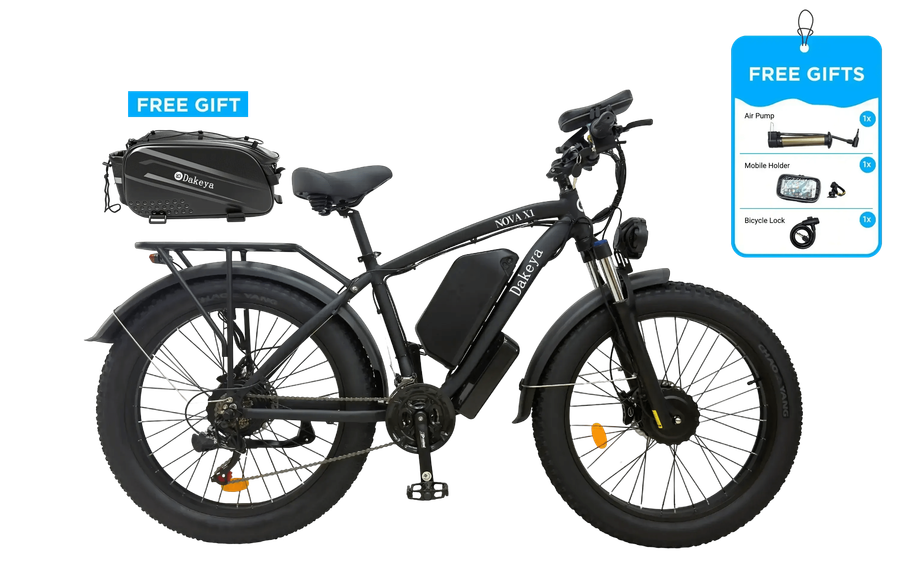
Dakeya NOVA X1 6000W dual motor fat tire electric bike, UL2849 certified
Beyond the UL2849 badge, a well-engineered e-bike pairs certified electronics with components that make the power usable and safe:
- A quality battery management system that balances cells and cuts off on overcharge or over-temperature.
- Hydraulic disc brakes for reliable stopping power — especially important on high-wattage bikes that reach 45–50 MPH.
- A durable frame rated for your weight plus cargo, with a stated load limit.
- Quality tires matched to how you ride — fat tires for off-road and all-season grip, for example.
- Transparent specs — real motor wattage, battery capacity in Wh, and honest range figures.
At Dakeya, our high-performance e-bikes and scooters are engineered around these principles. Our flagship Dakeya NOVA X1 6000W dual-motor e-bike is certified to UL2849, pairing a certified 60V battery with twin 3000W motors, hydraulic disc brakes, and full suspension for riders who want maximum power without compromising on safety. For a more budget-friendly certified option, the Dakeya DA03 5000W dual-motor e-bike and the Dakeya TS60 5000W fat-tire e-bike deliver the same UL2849-certified 60V platform with honest, published specs.

Dakeya DA03 5000W dual motor fat tire electric bike, UL2849 certified
Frequently Asked Questions
Is UL2849 required by law for e-bikes?
Not nationwide yet, but it's increasingly required by local laws (New York City being the most prominent example), apartment buildings, and insurance policies. It's quickly becoming the de facto standard for responsible e-bike brands.
Does UL2849 cover the battery alone or the whole bike?
The whole electrical system — battery, BMS, charger, controller, and wiring — tested as an integrated unit. That's what makes it stronger than component-only certifications.
Can a UL2849-certified battery still catch fire?
No certification makes a product indestructible, but UL2849 dramatically reduces the risk by testing for thermal runaway, overcharge, and physical abuse. Proper care — using the included charger, avoiding extreme heat, and not riding with a damaged battery — matters too.
Is UN38.3 the same as UL2849?
No. UN38.3 only certifies that a battery is safe to ship. UL2849 certifies that the e-bike's electrical system is safe to use and charge. Always look for UL2849, not just UN38.3.
Are higher-wattage e-bikes less safe?
Not inherently. Wattage affects speed and torque, not safety. What matters is whether the electrical system is properly certified and whether the components — brakes, frame, tires — are matched to the power output. A certified 5000W bike with hydraulic brakes can be safer than an uncertified 750W bike with weak brakes.
Conclusion
UL2849 isn't just a sticker — it's independent proof that an e-bike's electrical system was tested for the way you'll actually use it. As cities tighten rules and battery fires make headlines, buying a certified bike protects your safety, your home, and your peace of mind.
When comparing e-bikes, make UL2849 a non-negotiable box to check — then verify it with the UL file number. Pair that with hydraulic brakes, a solid frame, and honest specs, and you'll have a bike that's as safe as it is fun to ride.


Share:
How Long Do E-Bike Batteries Last? Range, Lifespan & Replacement Cost (2026 Guide)