
Introduction
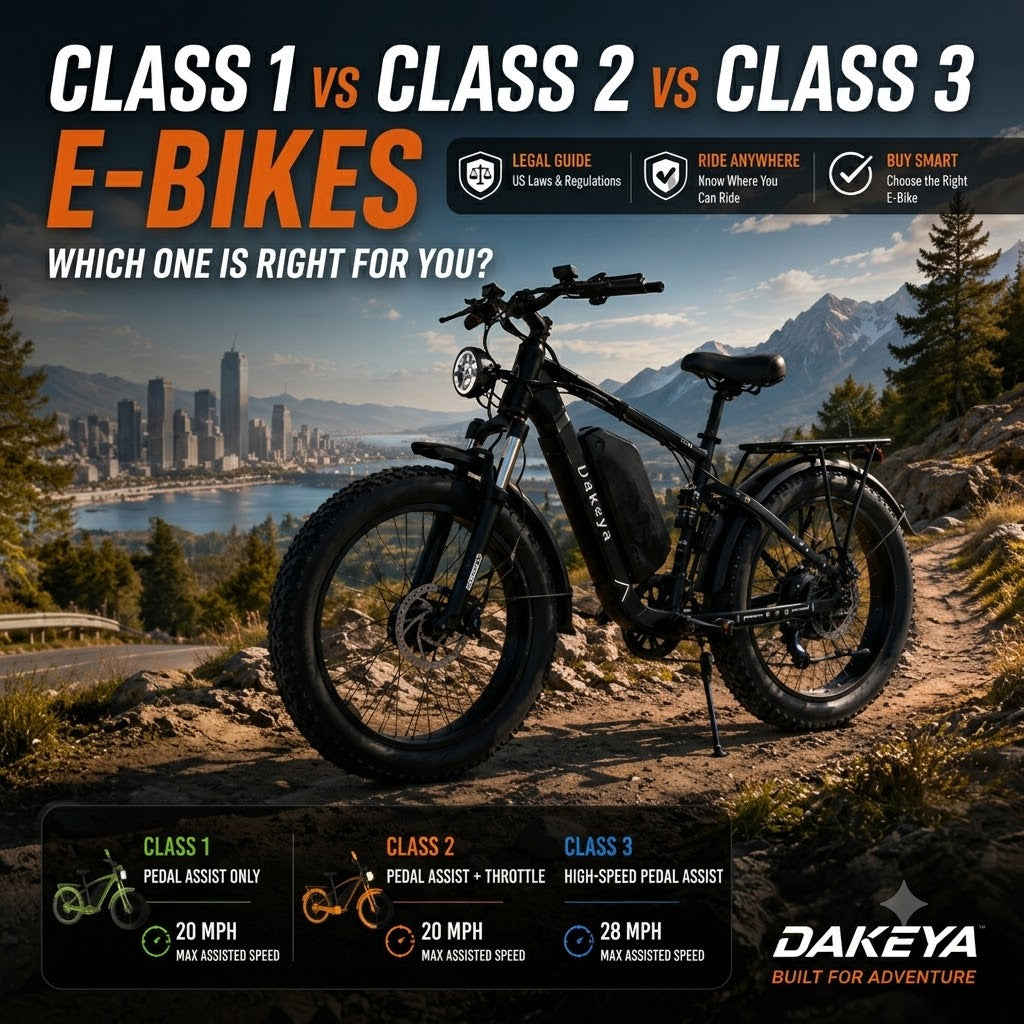
If you've shopped for an e-bike in the United States, you've almost certainly seen the three official classifications: Class 1, Class 2 and Class 3. Many first-time buyers ask the same core question: what's the difference between Class 1, Class 2 and Class 3 e-bikes? This simple question carries massive real-world consequences. Pick the wrong class, and you could face fines, be banned from local bike paths, or end up with an electric bike that fails to match your daily commute, off-road plans or storage needs.
The U.S. standardized three-class e-bike framework launched in 2015 to unify state and municipal traffic laws. Instead of treating every electric bicycle as a motor vehicle or a regular bike, regulators split e-bikes by motor operation, maximum assisted speed and throttle functionality. Today, most U.S. states have adopted some form of the three-class system, although specific regulations regarding trail access, helmets, rider age and equipment requirements may vary by state and local jurisdiction.
E-Bike Class Comparison at a Glance
| Feature | Class 1 | Class 2 | Class 3 |
|---|---|---|---|
| Motor Type | Pedal-assist only | Pedal-assist + throttle | Pedal-assist (throttle up to 20 mph on some models) |
| Max Assisted Speed | 20 mph | 20 mph | 28 mph |
| Throttle | No | Yes | Limited (up to 20 mph where permitted) |
| Trail Access | Most trails allowed | Partial — varies by location | Paved roads only |
| Helmet Requirement | Varies by state | Varies by state | Often mandatory (16+ in many states) |
| Best For | Trail riding, fitness, casual use | Errands, hills, mobility needs | Long urban commutes |
Class 1 E-Bikes: Pedal-Assist Only, 20 mph Max Assisted Speed
Class 1 is the most universally accepted e-bike category in the United States. The motor only activates when you pedal, providing assistance up to 20 mph — after which the motor cuts out and you continue under your own power. There is no throttle on a Class 1 e-bike.
This design makes Class 1 the go-to choice for trail riders, fitness cyclists and anyone who wants maximum access to bike paths, park greenways and mountain singletracks. Because the riding experience closely mirrors a traditional bicycle, most trail systems and municipalities that allow regular bikes also permit Class 1 e-bikes. They are also popular for multi-modal commutes — lightweight folding Class 1 models pair easily with trains and subway systems for door-to-door travel.
Class 2 E-Bikes: Throttle-Equipped, 20 mph Max Assisted Speed
Class 2 shares the same 20 mph maximum assisted speed as Class 1, but adds one key feature: a throttle. Riders can engage the motor without pedaling at all, making Class 2 ideal for stop-and-go urban environments, hilly neighborhoods and anyone who needs on-demand power without leg effort.
The throttle is particularly valuable for riders recovering from injuries, parents carrying cargo or food delivery workers who make frequent stops. However, the throttle also triggers trail restrictions in many jurisdictions — urban park systems and mountain bike trails that welcome Class 1 bikes often ban Class 2 models. Always check local rules before assuming trail access.
Class 3 E-Bikes: High-Speed Pedal Assist, 28 mph Max Assisted Speed
Class 3 is built exclusively for fast urban commuting. Motor assistance runs up to 28 mph — 8 mph faster than Class 1 and Class 2. Some Class 3 models include a throttle that operates up to 20 mph where permitted under applicable regulations, while many others are pedal-assist only. Riders should always verify the requirements in their state.
This speed advantage makes Class 3 ideal for covering 10+ mile daily commutes, keeping pace with slow-moving city traffic and cutting travel time during morning rush hour. However, restrictions are the strictest of all three classes. Nearly every national park, mountain bike trail and residential multi-use path prohibits Class 3 e-bikes. Many states enforce mandatory helmet laws and a minimum rider age of 16 for Class 3 operation, with extra rules in California, New York and Pennsylvania.

Where Can You Legally Ride Each E-Bike Class? State & Trail Breakdown
The biggest reason to understand e-bike classification is avoiding costly tickets or trail access denial. Below is a clear breakdown of permitted locations for every class, aligned with 2026 U.S. traffic codes.
1. Class 1 E-Bike Permissions
- All paved city bike lanes, public streets and residential roads (100% legal nationwide)
- Multi-use recreational trails, park greenways and most mountain bike singletracks
- Boardwalks, river paths and campus cycling routes in nearly every state
- Very few blanket bans — this is the most trail-friendly classification for casual riders and outdoor enthusiasts. Class 1 remains one of the most popular e-bike categories in the United States because it is widely accepted on bike paths and recreational trails.
2. Class 2 E-Bike Permissions
- Fully legal on public city roads, bike lanes and commercial thoroughfares
- Partial access to multi-use trails: allowed in rural areas, restricted or banned in dense urban park systems
- Usually prohibited on narrow mountain singletracks and pedestrian-heavy waterfront paths
- No universal helmet mandate in most states, though local cities often recommend protective headgear
3. Class 3 E-Bike Permissions
- Restricted to paved public roads and dedicated vehicle/bike arterial lanes
- Banned from all standard multi-use trails, national park cycling routes and most mountain bike trails
- Many states require functional speedometers on all Class 3 e-bikes for law enforcement verification
- Mandatory helmet rules for all riders under 18 in California, Texas, New York and Florida; some states extend helmet requirements to all ages for Class 3 models
Regional differences remain important to research before purchasing. For example, California allows Class 1 and Class 2 bikes on most local trails but limits Class 3 to city roadways only. New York City restricts all throttle-heavy Class 2 e-bikes in certain park zones, while Texas applies a minimum rider age of 15 for Class 3 operation. Always cross-check your county's transportation department rules before planning trail trips.
Who Should Ride Each E-Bike Class? Matching Classification to Your Lifestyle
Class 1 Best For: Trail Riders, Fitness Cyclists, Casual Weekend Users
If your main riding involves park trails, mountain paths, light fitness rides or short neighborhood trips, Class 1 is the perfect choice. Seniors, recreational cyclists and apartment dwellers who prioritize universal trail access will benefit most from pedal-only assist without throttle limitations. Folding Class 1 e-bikes also excel for multi-modal commutes combining bikes, trains and subway transit, as they carry lightweight, low-power designs that are easy to store indoors or on public transport racks.
Class 2 Best For: Grocery Shoppers, Delivery Workers, Riders With Mobility Limits
Class 2's throttle system solves daily small-task pain points. Riders recovering from knee injuries, parents hauling groceries or food delivery staff rely on throttle power to avoid exhausting pedaling. If you live in a hilly suburban neighborhood and frequently stop-start at driveways or crosswalks, instant throttle power eliminates the struggle of restarting uphill without heavy leg effort. Compact cargo and folding Class 2 models rank among top-selling budget e-bikes under $1,000 on U.S. retail platforms.
Class 3 Best For: Long-Distance Urban Commuters, Rush-Hour Travelers
Professionals with 8–20 mile one-way commutes gain the largest time savings from Class 3's 28 mph assist cap. When city traffic crawls at 25–30 mph, Class 3 e-bikes maintain steady speed without burning excess calories or arriving sweaty at the office. Daily downtown riders, suburban-to-city commuters and couriers traveling wide metropolitan areas get maximum efficiency from high-speed pedal assist, though they must accept limited trail access outside paved road networks.

Looking for a Powerful Class 2/3 Style E-Bike?
If you're looking for a high-performance fat tire electric bike designed for private land riding and off-road adventures, the Dakeya DA03 is worth considering.
It features:
- Dual motor system
- Full suspension frame
- Hydraulic disc brakes
- UL 2849 certified electrical system
- Fat tires for sand, snow and trail riding
Depending on your local regulations, riders can enjoy everyday commuting in compliant riding modes while also benefiting from the additional capability available for off-road use.

Critical Safety Rule: UL-Certified Lithium Batteries for All US E-Bike Classes
No matter which classification you select, battery safety certification should be a top priority. Several U.S. jurisdictions — including New York City and California — have adopted or encourage UL-certified e-bike electrical systems. Even where it is not legally required, choosing a UL-certified e-bike is widely recommended. California, New Jersey and New York City have enforced strict UL 2849 standards covering full e-bike electrical systems, alongside UL 2271 battery pack testing to prevent thermal runaway and battery fires.
Uncertified cheap imported e-bikes face seizure by customs, retail sales bans and fire hazards inside apartments or home garages. Reputable brands like Dakeya integrate removable 48V NCM lithium battery packs built with full BMS overcharge, over-discharge and short-circuit protection, fully compliant with U.S. UL standards for Class 1, 2 and 3 models. When comparing any e-bike, always confirm battery UL certification before purchasing — this safety requirement applies equally to all three classification tiers and cannot be overlooked for indoor charging or daily home storage.
Example of a UL-Certified High-Performance E-Bike
When evaluating higher-powered electric bikes, safety certification becomes even more important. For example, the Dakeya DA03 uses a UL 2849-certified electrical system, combining dual motors with hydraulic brakes and a full-suspension frame while prioritizing battery safety. Regardless of the brand you choose, verifying certification is one of the most important steps before purchasing an e-bike.

Common Buyer Mistakes When Choosing E-Bike Class
- Buying Class 2 expecting full trail access: Many new shoppers overlook local throttle bans on multi-use trails and waste budget on bikes they cannot ride on favorite park paths. If trail riding is a priority, stick to Class 1.
- Selecting Class 3 for short casual trips: The higher speed capability adds unnecessary cost and severe trail restrictions for users only riding 2–3 miles daily around neighborhoods.
- Ignoring UL battery certification to save money: Non-certified lithium packs carry fire risk and fail state sales regulations, risking product confiscation and safety hazards during indoor charging.
- Misunderstanding throttle limits on Class 3 bikes: Shoppers mistakenly believe Class 3 hits 28 mph via twist throttle; federal rules cap all throttle output at 20 mph regardless of classification.
Final Checklist to Pick Your Ideal E-Bike Class
Ask these four simple questions to eliminate confusion between Class 1, Class 2 and Class 3:
- Do I regularly ride multi-use park trails or mountain bike paths? → Choose Class 1
- Do I need instant throttle power for hills, grocery runs or mobility limitations? → Choose Class 2
- Is my primary use long-distance fast city commuting over 8 miles one way? → Choose Class 3
- Will I store and charge my e-bike indoors in an apartment? → Prioritize UL-certified removable lithium batteries across all classes.
Conclusion
The core difference between Class 1, Class 2 and Class 3 e-bikes boils down to three simple variables: throttle availability, maximum assisted speed and legal trail access. Class 1 delivers unrestricted trail access with pedal-only assist capped at 20 mph. Class 2 adds convenient throttle functionality but faces widespread trail restrictions. Class 3 unlocks 28 mph fast commuting power yet is limited exclusively to paved public roadways in most U.S. regions.
As U.S. e-bike regulations tighten around UL lithium battery safety and local trail rules evolve each year, matching your bike classification to your daily riding habits prevents fines, access bans and wasted investment. Whether you are a weekend trail explorer, suburban errand runner or daily office commuter, one of the three standardized e-bike classes will align perfectly with your speed, convenience and legal access needs. Always verify your local city and state traffic ordinances before finalizing your purchase to ride safely and legally across America's roads, bike lanes and recreational paths.


Share:
Dakeya Da03 REBEL OFF ROAD eBike: 5000W Dual Motor, Full Suspension