
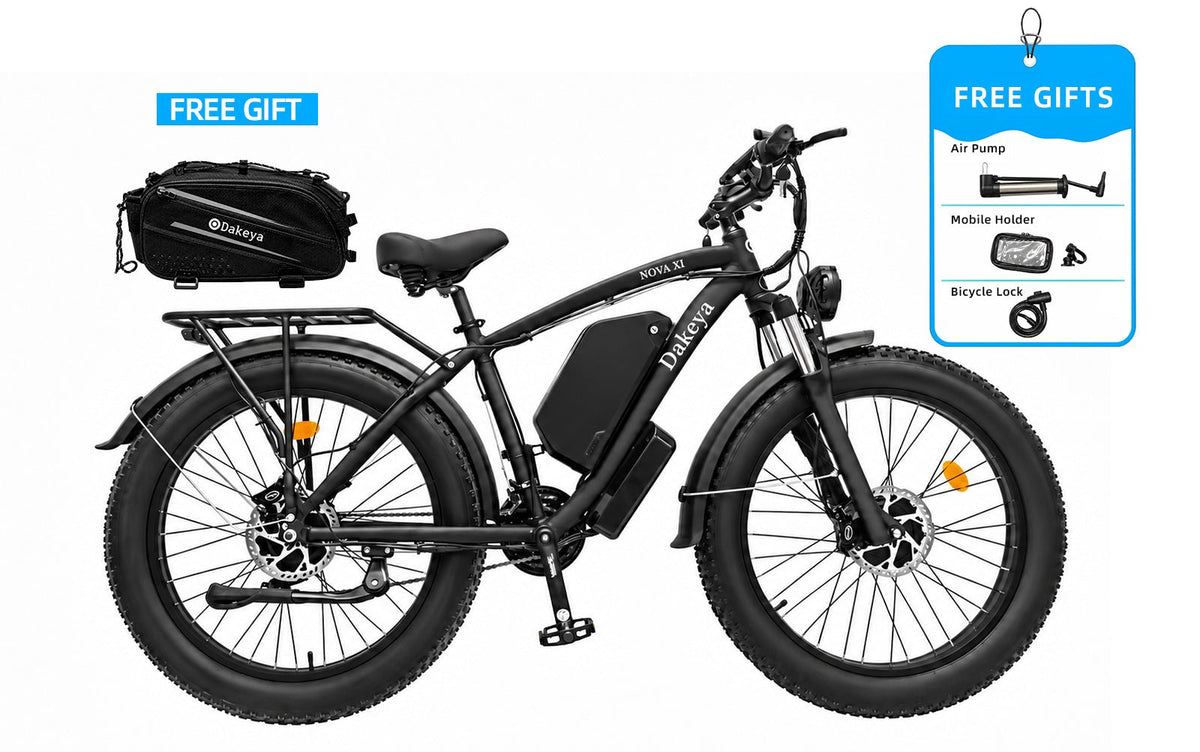
What do real riders notice after watching a long-form e-bike review? Usually not the headline wattage alone. They ask whether the battery shown in the video matches the bike being sold, whether dual motors remain useful on hills, how suspension feels on rough ground, whether a heavier rider can control the bike, and what compromises appear after the first burst of acceleration.
We reviewed two third-party YouTube videos and their public comment discussions: Maximum Charge’s NOVA X1 review and Papa’s Product Reviews’ DA03 review. As captured on November 10, 2026, the NOVA X1 video had about 6,004 views, 156 likes and 79 public comments and replies; the newer DA03 video had about 5,617 views, 29 likes and 8 public comments and replies. Counts change over time, and comments are individual opinions—not controlled laboratory evidence—but the questions are useful because they reveal what buyers still need to know before ordering.
Quick answer: the comments suggest that both bikes attract interest for power and value. The NOVA X1 discussion is deeper but also more skeptical about battery configuration, voltage sag, suspension and competing models. The DA03 discussion is smaller and mostly positive, with repeated praise for torque, hill performance, suspension and value. The practical lesson is to match the exact retail version to your route, body size and local rules rather than buying from a single number or creator quote.

How we used the review comments
This is not a popularity contest and it is not a claim that every commenter owns either bike. We used the discussions as a buyer-question audit: which points generated repeated questions, comparisons, objections or purchase signals?
- Purchase intent: questions about price, extra batteries, fit, transport and where to buy.
- Performance confidence: comments about acceleration, hills, traction, suspension and braking.
- Trust: whether the reviewed battery and specifications match the current sales page.
- Competitive pressure: viewers comparing the bikes with similarly priced alternatives.
- Ownership concerns: battery reserve, voltage drop, manuals, replacement parts and support.
We did not treat creator statements or comments as certification evidence. Performance varies with rider mass, charge level, temperature, terrain, tire pressure, setup and local speed restrictions.
NOVA X1: strong engagement, but buyers want version-level proof
The NOVA X1 video generated the larger discussion relative to its channel size. Viewers asked about sand, rider height, extra batteries, transport length, drivetrain behavior and alternatives. That is valuable attention—but several threads show why attention does not automatically become a sale.
1. Battery configuration became the central trust question
The most important NOVA X1 discussion concerned the capacity of the battery on the reviewed unit versus information viewers had seen on a sales page. The current NOVA X1 product page lists a 1500Wh nominal battery. The Maximum Charge review and its comments discuss a different capacity on the reviewed bike. That does not prove every unit is the same or that every comment is correct; it proves that the review unit, battery label and current retail listing must be matched explicitly.
Before buying, ask for a current photograph of the battery label or written confirmation for the exact variant. Do not infer amp-hours from an older video, and do not assume a creator’s test applies to a later configuration. For Dakeya, the operational lesson is equally clear: product page, manual, advertising and reviewer briefing must use one verified specification set.
2. Dual-motor power raised battery and traction questions
Some technically minded viewers discussed voltage drop under heavy load and whether a second battery would improve the experience. These comments should not be treated as engineering conclusions about every bike. They do show what high-performance buyers care about: the battery must deliver power predictably, and the rider needs to know when dual-motor mode is useful.
Two driven wheels can improve the distribution of force when traction is available, but they cannot create grip on every surface. On sand, snow, mud or a turn, abrupt front-wheel power can reduce predictability. Practice the documented modes in a permitted area, use progressive inputs and reduce speed before the surface becomes uncertain.
3. Suspension and pedal response can outweigh peak power
Several viewers focused on the NOVA X1’s lack of dedicated rear suspension and on the feel of its pedal-assist response. The current NOVA X1 page lists front suspension. That may suit riders prioritizing a simpler layout, but it is not the same comfort proposition as a bike with an additional central shock.
If your normal route includes broken pavement, roots or repeated washboard surfaces, compare suspension layout, tire pressure, saddle setup and riding posture—not only motor output. If pedal response matters, ask how assistance begins, whether the bike uses cadence or torque sensing, and whether a test ride or exact-model demonstration is available.
4. Competitor comparisons can redirect the sale
Viewers compared the NOVA X1 with other dual-motor fat-tire bikes and sometimes preferred a smaller frame, different suspension or another battery arrangement. That is normal in a considered purchase. A trustworthy product page should make comparison easier by stating the current tire size, suspension layout, battery energy, total-load limit, warranty scope and legal-use caveat in plain language.

DA03: fewer comments, but clearer positive buying signals
The DA03 review is newer and appeared on a much larger channel, yet its public discussion was much smaller. That means the sample is limited. Still, the visible comments repeatedly highlighted torque, power for the price, display quality and suitability for a larger rider. One commenter said the review led them to buy a bike, which is a meaningful purchase signal—but it is not independently verified order attribution.
1. Hill performance was the strongest proof point
The review showed a rider of more than 230 lb climbing steep sections, including throttle-only and low-effort pedaling examples. Viewers responded positively to the apparent torque and value. Treat this as one rider’s test under the conditions shown, not a guaranteed grade rating. The exact slope, surface, battery charge and weather were not independently measured for this article.
A useful comparison question is not “Can it climb hills?” but: “Can the exact bike handle my total load on a climb of approximately this grade and length, with enough braking and battery reserve for the descent and return?”
2. Front plus central suspension matched rough-route interest
The current DA03 product page lists front plus central suspension, 26 × 4.0-inch tires and hydraulic disc brakes. The reviewer’s rough-surface sections generated a positive response because the extra suspension component addresses a concrete buyer need: comfort and control on uneven ground.
Suspension does not make every trail appropriate or legal. Setup, speed, rider technique, tire condition and route permission still matter. Ask how the suspension is adjusted for your weight and whether service instructions are included.
3. “Power for the price” attracted interest, but attribution is incomplete
The DA03 video description and pinned comment include a Dakeya link, an Amazon link and the code PAPA100. That is better than an untracked generic link, but public YouTube metrics alone cannot tell us how many viewers clicked, added to cart or purchased. A proper review partnership should report link clicks and code-attributed orders at 7 and 30 days.

What the two discussions say side by side
| Buyer question | NOVA X1 discussion | DA03 discussion |
|---|---|---|
| Most visible attraction | Dual-motor power, speed, controls and value | Hill torque, full-suspension feel and value |
| Main objection | Reviewed battery/version clarity, voltage drop, rear comfort and competitor comparison | Limited comment sample; viewers still need measured fit, range and ownership evidence |
| Current listed suspension | Front suspension; no dedicated rear suspension | Front plus central suspension |
| Current listed battery | 1500Wh nominal | 60V 25Ah / 1500Wh nominal |
| Best fit for the decision | Riders prioritizing the higher published combined peak figure and 24-inch fat tires, after confirming exact version and fit | Riders prioritizing the additional central suspension and 26-inch fat tires, after confirming fit and route suitability |
This table summarizes current product-page information and discussion themes. It is not a promise of speed, range, hill grade or rider fit.
Seven questions to answer before choosing either bike
- Which exact battery is included? Confirm voltage, amp-hours or watt-hours from the current listing and battery label.
- Does the review show the same retail version? Check suspension, display, wheel size, battery and controller configuration.
- What is your total load? Include rider, clothing, lock, water, accessories and cargo.
- What does your route demand? Record climb grade and length, surface, stopping room and return distance.
- Which suspension layout do you need? Front-only and front-plus-central designs serve different comfort priorities.
- Can you store and transport it? Confirm assembled dimensions and weight before choosing a rack or indoor storage location.
- Is the intended use legal? High-power configurations may fall outside ordinary e-bike classes. Check state, local and land-manager rules.
How to interpret creator tests responsibly
- A displayed top speed is one observed result, not a guarantee.
- A hill climb needs rider weight, slope, length, surface, charge level and drive mode to be useful.
- A remaining battery icon is not a precise range measurement.
- Affiliate links and discount codes should be disclosed; they do not automatically make a review false, but the relationship matters.
- Comments can reveal questions and objections, but they do not replace service records, controlled tests or verified product documentation.
The U.S. Consumer Product Safety Commission’s micromobility guidance recommends checking the brakes, throttle, lights, tires, cables and frame before riding; following local traffic laws; wearing a helmet; and using only the supplied or manufacturer-recommended charger and compatible replacement battery.
NHTSA bicycle safety guidance also emphasizes fit, working brakes, visibility, helmet use and predictable riding. These general sources do not certify either model or determine where a high-power configuration is legal.

Our transparent takeaway
The reviews did have an effect: they produced real questions, comparisons and at least one stated purchase signal. The reason the effect can feel weak is that views do not equal attributable sales. NOVA X1 drew stronger discussion but also exposed version and trust questions. DA03 produced positive reactions but a smaller discussion relative to the channel’s audience.
For buyers, the best next step is to compare the current NOVA X1 listing and current DA03 listing, then send Dakeya your height, inseam, total load, usual terrain and storage situation through the contact page. If the reviewed configuration and current listing differ, ask for written clarification before ordering.
Watch the source reviews
- Maximum Charge: NOVA X1 long-form review — public metrics and comments captured November 10, 2026.
- Papa’s Product Reviews: DA03 long-form review — public metrics and comments captured November 10, 2026.
Related reading
- NOVA X1 vs. DA03: specifications and buying differences
- Front suspension vs. front plus central suspension
- How to choose an e-bike for hills
- User manuals and installation guides
By the Dakeya Editorial Team. Review metrics and public discussions were checked on November 10, 2026. Current NOVA X1 and DA03 product-page specifications were checked on November 11, 2026. Creator opinions and public comments are quoted or summarized as individual observations, not Dakeya guarantees, engineering certifications or proof of legal access. Review links may use affiliate codes or relationships disclosed by the creator or product page.


Share:
24-Inch vs. 26-Inch Fat-Tire E-Bike: Choose by Fit, Storage and Terrain
Dakeya NOVA X1 Review: Strengths, Limitations & Who It’s For