
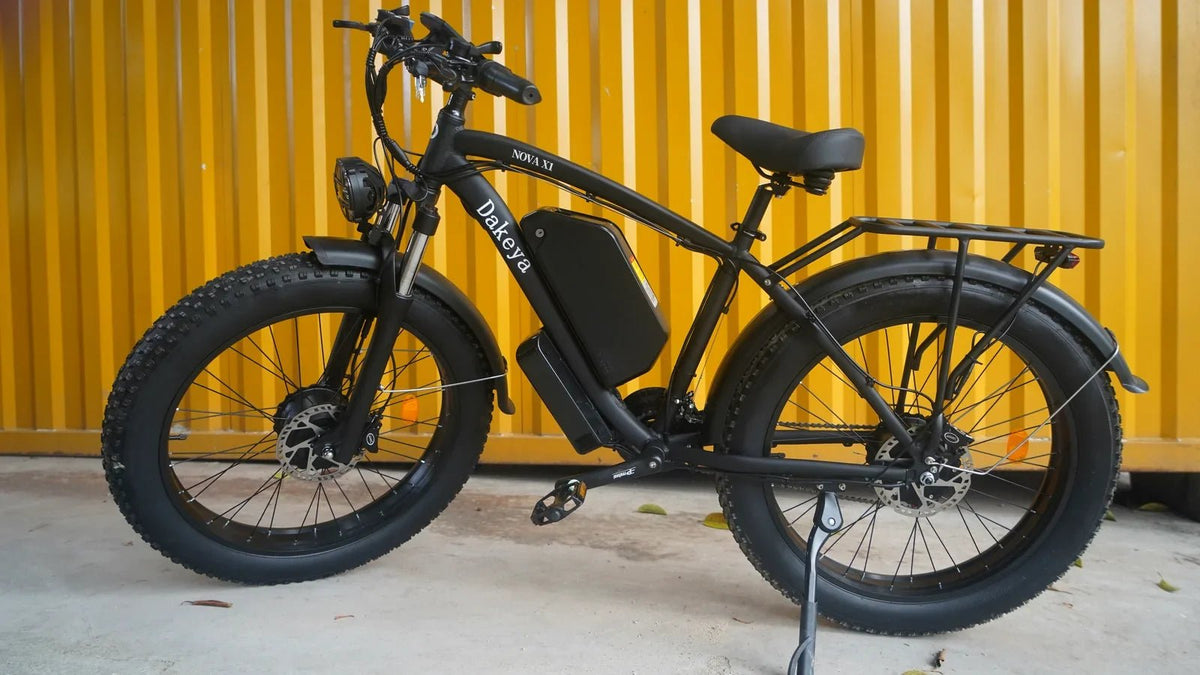
Ordering a high-performance fat-tire e-bike is different from ordering a small parcel. The carton is large, the bike is heavy, some final assembly is required, and the first ride should begin only after the battery, controls, fasteners, brakes and tires have been checked against the instructions for the exact model.
This guide explains what U.S. buyers can expect after ordering a Dakeya NOVA X1 or Dakeya DA03: processing and delivery, package inspection, model-specific assembly resources, battery and charger checks, rider-fit checks and a controlled first ride. It is a preparation guide—not a substitute for the supplied manual or qualified bicycle service.

Quick answer: what happens after checkout?
- Order processing: current in-stock product guidance states that orders normally process within 1–2 business days.
- Transit: after processing, eligible continental U.S. deliveries are estimated at approximately 5–7 business days. This is an estimate, not a guaranteed arrival date.
- Tracking: watch the email address used at checkout and review every tracking number provided.
- Delivery: plan for a large, heavy carton and arrange adult help before it arrives.
- Inspection: photograph the unopened carton and inspect the bike, battery, charger and accessories before discarding packaging.
- Final assembly: follow only the instructions for your exact model. If anything is unclear, pause and contact Dakeya support.
- First ride: begin in a low-risk, controlled area only after the mechanical and electrical checks are complete.
For current service-area details, exclusions and carrier information, read the Dakeya Shipping Policy before ordering.
Will the bike and battery arrive together?
The NOVA X1 and DA03 product pages state that the bike and battery normally ship together. Carrier or lithium-battery handling requirements can sometimes produce separate packages and separate tracking numbers. One package arriving first does not automatically mean the order is incomplete.
Check all tracking notices before reporting a missing component. If the tracking information is inconsistent, or a package shows delivery but cannot be located, contact Dakeya support with the order number and carrier details.
Before delivery: prepare the space and tools
Choose a dry, well-lit work area with enough room to protect the bike’s paint, cables and brake components. Keep children and pets away from loose packaging, tools and the battery. A second adult is strongly recommended for stabilizing or lifting a large fat-tire bike.
- Open the exact-model manual or installation resource before starting.
- Use the supplied tools only where the instructions call for them.
- Do not guess torque values or substitute steps from a similar-looking bike.
- Do not use the brake levers while a wheel or brake spacer is removed unless the instructions explicitly permit it.
- Do not lift the bike by the display, cables, fenders or battery handle.
Current resources are collected on the User Manuals & Installation Guides page. If the newest NOVA X1 or DA03 revision is not listed, request the correct file before proceeding rather than relying on an unrelated video.
Inspect the package before throwing anything away
Take clear photos of all sides of the carton before opening it, especially dents, tears, holes, crushed corners or wet areas. After opening, keep the carton, protective foam, spacers and accessory boxes until the bike has been inspected and tested.
Check the main components
- Frame and fork for dents, cracks, deep scratches or obvious misalignment
- Wheels and tires for visible damage or distortion
- Brake rotors and calipers for shipping damage
- Handlebar, controls, display and cable routing
- Battery case, connector area, lock and charger
- Loose-part box and model-specific accessories
If the battery is swollen, punctured, wet, unusually hot or visibly damaged, do not charge or install it. Move away from flammable materials if it is safe to do so and contact support for instructions. The available battery documentation relates to transport testing for the applicable battery sample; it is not a complete-bike UL 2849 certification.

Assembly: use the exact-model sequence
Final assembly requirements can vary by production revision and delivered configuration. The NOVA X1 and DA03 should not be assembled from memory or from a generic e-bike tutorial. Follow the supplied manual and the current Dakeya resource for the exact model.
Common delivery-stage tasks on partially assembled e-bikes may include positioning the handlebar, installing the front wheel, pedals or accessories, and checking the battery installation. That list is intentionally not a step-by-step instruction: the order, hardware, spacers, thread direction and torque requirements must come from the model documentation.
Stop and ask for help when:
- a part does not align without force;
- a cable is pinched, stretched or routed against a moving part;
- the front wheel or axle does not seat correctly;
- a brake rotor rubs heavily or appears bent;
- a fastener will not start cleanly by hand;
- the battery does not slide, latch or lock as described;
- you are unsure which washer, spacer or bolt belongs in a location.
A qualified bicycle technician is the safer choice when you are uncertain about wheel retention, brakes, steering or drivetrain setup.

NOVA X1 and DA03: what differs during setup?
Both current product pages list 26 × 4.0-inch fat tires, hydraulic disc brakes, a 60V 25Ah battery and high-power dual-motor systems. However, they should not be treated as identical bikes.
| Setup point | NOVA X1 | DA03 |
|---|---|---|
| Motor description | Dual 3000W peak motors; 6000W total peak listed | 2500W front + 3000W rear peak; 5500W combined peak listed |
| Suspension shown on current page | Front suspension | Front and center suspension |
| Published bike weight | Confirm the current delivered specification with support | 89 lb listed |
| Cargo hardware | Confirm accessories included with the order | Current page lists a rear-rack capacity; verify installation against the manual |
For a broader model comparison, see NOVA X1 vs DA03, but use the current product pages and supplied documents for final specifications.


Battery and charger checks before the first use
- Confirm the battery and charger match the model and order documentation.
- Inspect the battery case, charging port, cable and plug for damage.
- Use only the supplied or manufacturer-approved charger.
- Charge in a dry, ventilated location away from flammable materials.
- Do not charge unattended, on an escape route or near a heat source.
- Ensure the battery is fully seated and locked before riding.
Battery state of charge, storage history and ambient temperature can affect the first charge. Follow the supplied instructions rather than assuming a fixed charging time.
Mechanical checks before powering on
Perform these checks with the bike stable and the power off:
- Handlebar and stem are aligned and secure.
- Front and rear wheels are properly retained.
- Tires are undamaged and inflated within the permitted range printed on the tire or specified in the manual.
- Both brake levers operate and do not pull to the grip.
- Brake rotors are not visibly damaged and the wheels rotate without severe resistance.
- Pedals, crank area and visible fasteners are correctly installed.
- Cables do not pull tight when the handlebar turns fully left and right.
- Battery is locked and cannot move in its mount.
Then follow the full high-power e-bike pre-ride checklist. Never use motor power to “test” an incompletely assembled bike.
Set the bike to the rider before the first ride
Adjust the saddle and controls only within the permitted ranges. The rider should be able to mount and dismount deliberately, reach both brake levers and turn the handlebar without cables binding. A very low saddle may help a cautious first test, but the final pedaling position should be set according to the manual and rider fit.
Check that clothing, shoelaces and cargo cannot contact the chain, wheels or brake rotors. Remove loose tools and packaging from the bike. Do not carry a passenger unless the product is specifically designed and equipped for one.

How to conduct the first low-speed test
Choose a flat, dry, traffic-free area where the bike is permitted. Wear an appropriate helmet and protective equipment. Start with the lowest practical assistance and power setting described by the manual.
- Power on while stationary and confirm the display has no unexplained warning.
- Test each brake at walking speed before increasing speed.
- Check steering response and listen for rubbing, clicking or knocking.
- Apply power gently; do not test maximum acceleration or speed.
- Stop after a short loop and inspect wheel retention, brakes, battery seating and visible fasteners again.
If handling feels unstable, braking is weak, the motor behaves unexpectedly, or the bike shows an error, stop riding and contact support or a qualified technician.
Public-road use requires a local legal check
The NOVA X1 and DA03 are high-performance models. Their maximum power and speed specifications may place them outside ordinary e-bike classifications in many jurisdictions. A speed setting alone does not necessarily determine legal classification.
Before using either bike on a public road, bike lane, sidewalk, trail or park route, check state and local rules for vehicle classification, permitted locations, registration, licensing, insurance, equipment and rider age. Where public use is not permitted, ride only on private property or other locations where the owner and local rules allow it.
Keep the packaging until the inspection is complete
Do not discard the carton and protective materials immediately. They may be needed to document shipping damage or to complete an authorized return. Review the 30-day return policy: verified defects, shipping damage or incorrect items are handled differently from non-defective returns, which may involve a restocking fee and documented insured return freight.
Never send the bike back without return authorization. Contact Dakeya first and preserve photos, video, serial information and packaging.
Frequently asked questions
Are NOVA X1 and DA03 delivered fully assembled?
They are delivered partially assembled. The exact final-assembly tasks can vary by model or production revision. Follow the supplied instructions and current model-specific resources.
Can I use a YouTube video for a similar bike?
Do not substitute a similar-looking model. Small differences in axles, brake spacers, fasteners, wiring and torque requirements matter. Use the exact-model resource or contact support.
What if the battery and bike have different tracking numbers?
Carrier and lithium-battery handling requirements can result in separate packages. Review all tracking notices and contact support if the complete shipment does not arrive as indicated.
Should I charge a visibly damaged battery?
No. Do not charge, install or use a battery that is swollen, punctured, wet, unusually hot or otherwise damaged. Contact support for safe next steps.
When should I throw away the carton?
Keep it until the bike has passed the delivery inspection, final assembly and a controlled low-speed test, and until any damage or missing-part issue has been resolved.
Where can I get help?
Use the contact page, email info@dakeyabike.com or call the current support number shown on the product page. Include your order number, model, photos and a concise description of the issue.
Choose your Dakeya model
NOVA X1: dual 3000W peak motors, front suspension and a 60V 25Ah battery listed on the current product page.
DA03: 2500W front + 3000W rear peak motors, front and center suspension, and a 60V 25Ah battery listed on the current product page.
Specifications, inventory and included accessories can change. Confirm the live product page and order documents before purchase.


Share:
How to Match a Fat-Tire E-Bike to Your Route: Pavement, Grass, Gravel & Rough Paths
High-Power E-Bike Maintenance Schedule